The Talent Market Is Rewriting Its Rulebook
For decades, academic degrees were considered the primary signal of employability. A candidate’s educational background often defined hiring decisions and career opportunities. Today, that signal is evolving rapidly.
Across global markets, employers are shifting from asking where a candidate studied to evaluating what they can actually do. This shift is not simply a hiring trend. It represents a fundamental transformation in how organizations design and build future-ready workforces. For staffing and talent partners, this evolution is redefining how talent is sourced, validated, and deployed.
The Global Shift Toward Skills-First Hiring
The move toward skills-based hiring is no longer experimental. It is quickly becoming mainstream across industries and geographies. Recent workforce insights indicate that around 80% of organizations are actively working toward skills-based hiring approaches, focusing on demonstrated competencies rather than formal education alone. Approximately 83% of companies are adopting or transitioning to skills-based talent models, recognizing skills as a critical workforce currency. Globally, nearly 85% of employers now use some form of skills-based hiring, and more than half have removed degree requirements for selected roles.
This transformation is being driven by three major forces. The first is rapid technology evolution, which is continuously redefining job roles. The second is persistent skill shortages in high-demand domains. The third is the accelerating influence of artificial intelligence, which is reshaping how work is performed. From artificial intelligence and cloud computing to cybersecurity and data engineering, the half-life of technical skills is shrinking. Organizations can no longer depend solely on traditional academic pipelines to meet workforce demands.
What Leading Staffing and Recruitment Firms Are Observing
Global staffing and recruitment leaders are already operating within this new hiring reality.
Industry trends show that between 75% and 80% of recruiting professionals now prioritize skills over degrees in hiring mandates. Recruiters are also reporting a 25% to 30% increase in skill-based candidate searches across professional hiring platforms. In many staffing portfolios, more than 60% of open roles no longer require strict degree qualifications.
These insights reinforce an important shift in employer behavior. Organizations are redesigning job descriptions and hiring strategies around capabilities and outcomes rather than credentials alone.
How Artificial Intelligence Is Accelerating the Skills Revolution
Artificial intelligence is fundamentally reshaping hiring signals and candidate evaluation models. Research suggests that candidates with AI-related skills can see interview success rates increase by 8 to 15 percentage points, even when their formal education is less traditional. At the same time, automation is reducing demand for repetitive tasks while increasing demand for higher-value cognitive, digital, and adaptive skills.
Organizations are increasingly hiring for capabilities such as learning agility, problem-solving ability, digital adaptability, and emotional intelligence. These capabilities often determine long-term performance and adaptability but cannot be measured through degrees alone.
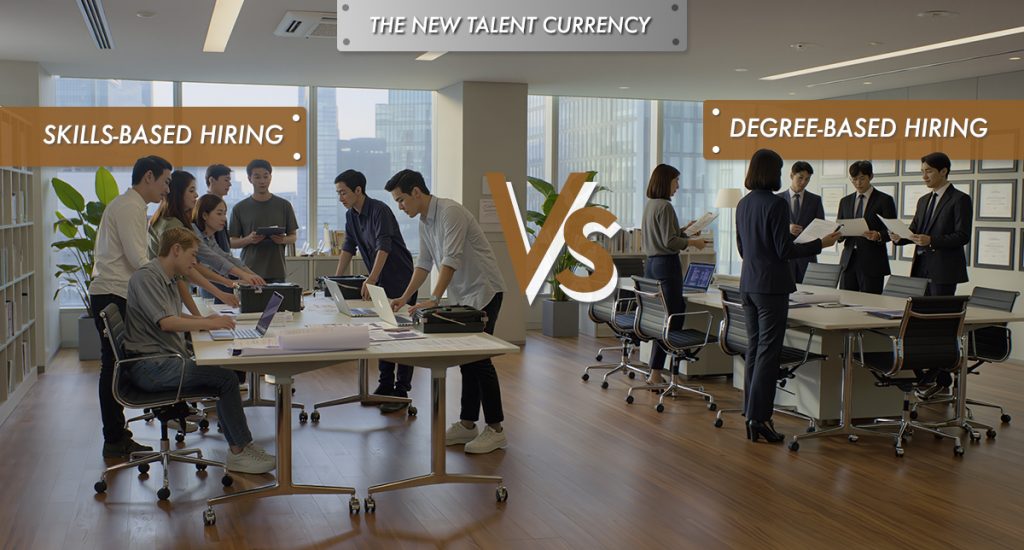
The Reality: It Is Not Skills Versus Degrees
Despite the strong shift toward skills-based hiring, degrees are not disappearing. Instead, their role is evolving. Degrees continue to provide structured foundational knowledge, professional discipline, access to strong professional networks, and recognized credential signals. However, modern hiring decisions are becoming multi-dimensional.
The future of hiring lies in multi-signal talent intelligence, combining skills, experience, learning ability, cultural alignment, and education where relevant.
blueStone Solutions Group Perspective: Building Skill-Powered Workforce Strategies
At blueStone Solutions Group, this shift is visible across global client mandates and workforce transformation initiatives. Forward-looking organizations are moving toward skill intelligence hiring models that use real-time labor market data to identify critical and emerging skill clusters. They are also adopting capability-based workforce planning, which focuses on hiring for future skill adjacency rather than immediate job fit alone. Additionally, organizations are building continuous talent ecosystems that combine full-time employees, contract professionals, gig workers, and project-based specialists into unified workforce strategies.
The strategic conversation has changed. Organizations are no longer asking whether a role can be filled. They are asking whether their workforce can be future-proofed.
The Strategic Risk of Not Adapting
Organizations that remain heavily degree-centric face several risks. These include reduced access to talent pools, slower hiring cycles, increased hiring costs, and lower workforce agility.
In contrast, organizations that adopt skills-first hiring approaches can significantly expand candidate access. In many cases, companies are unlocking candidate pools up to six times larger when shifting from job-title-based hiring to skill-based search strategies.
Moving the Conversation Forward
The future of hiring is not about choosing between degrees and skills. It is about building intelligent hiring ecosystems that recognize real capability, adaptability, and long-term potential. Organizations must evaluate whether they are hiring based on historical qualification signals or measurable capability and future readiness.
blueStone Solutions Group continues to partner with organizations to design and implement skill-powered hiring strategies that align with the future of work.