
The Shift from Talent Supply to Workforce Strategy
For decades, staffing was largely seen as a transactional function. Organizations approached staffing partners with a simple expectation — fill open roles quickly. Today, that expectation is rapidly changing. Companies are no longer just looking for candidates; they are looking for workforce ecosystems that can support long-term growth, resilience, and innovation.
The staffing industry is experiencing one of the most significant transformations in its history. Forward-thinking staffing partners are evolving from talent suppliers into Workforce Architects — strategic partners who design skills pipelines, workforce strategies, and talent models aligned with business outcomes. This shift is becoming visible across global markets and is redefining how organizations measure the value of staffing partnerships.
The New Market Reality: Workforce Complexity Is Rising
One of the biggest drivers behind this evolution is the growing complexity of workforce management. The global staffing market continues to expand and is projected to reach approximately $651 billion by 2035. At the same time, organizations are rapidly adopting new technologies and workforce models. More than half of companies are adopting AI-enabled recruitment. Many are shifting toward flexible workforce structures. A large portion of employees now need new digital skills to remain relevant. Contract-based hiring is also rising significantly across global markets. These trends clearly indicate that organizations are no longer satisfied with hiring support alone. They want partners who can help shape workforce strategy.
Talent Scarcity Is Driving Strategic Workforce Planning
Talent shortages are accelerating this transition. Across industries, skill scarcity is becoming a direct constraint on business growth. For example, in India’s defense technology sector, advanced engineering talent represents only a small share of the available workforce supply. Situations like this are forcing organizations to think long-term — mapping future skill demand, building early talent pipelines, creating reskilling ecosystems, and designing hybrid workforce models that combine permanent and flexible talent.
The Emergence of the Workforce Architect Model
Leading global staffing firms are expanding their capabilities far beyond recruitment. They are investing in workforce consulting, talent analytics, skills intelligence, employer branding strategy, and managed workforce programs. The future of staffing is becoming design-led, data-driven, and outcome-focused, where success is measured not just by hiring speed but by business impact and workforce sustainability.
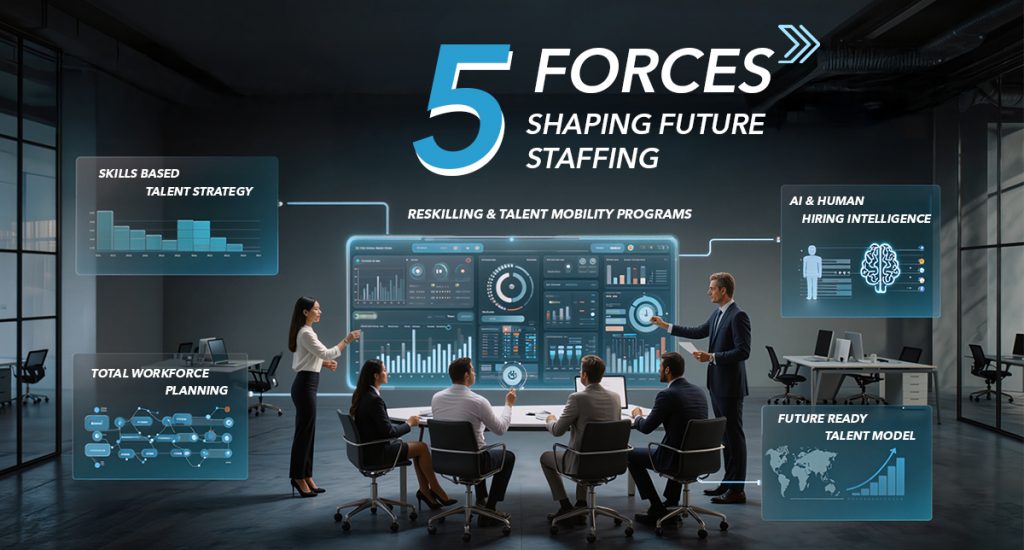
Five Capabilities Defining Next-Generation Staffing Partners
Skills Intelligence and Workforce Forecasting
Using market data and hiring analytics to predict future skill demand.
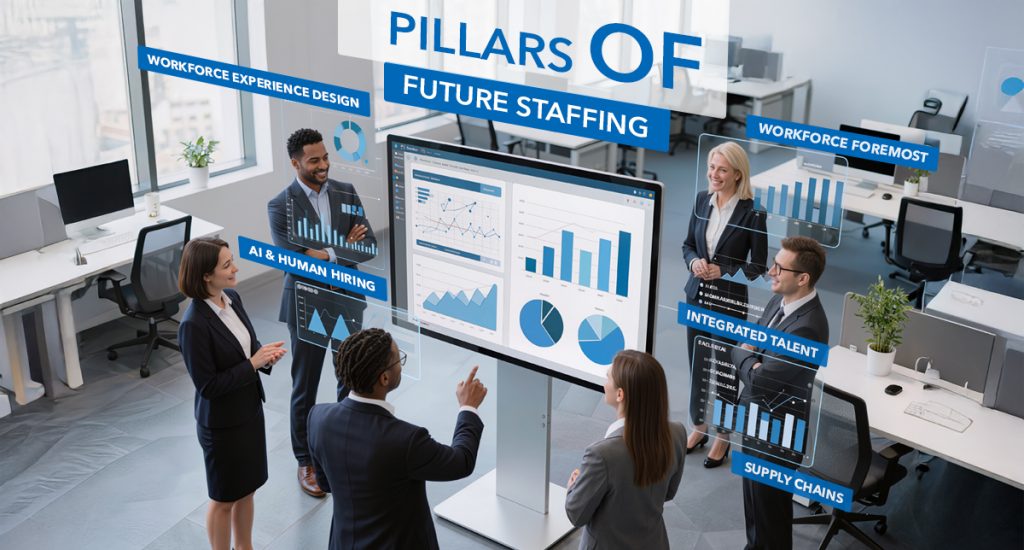
Workforce Experience Design
Integrating culture, engagement, and productivity into workforce planning.
Integrated Talent Supply Chains
Combining permanent, contract, gig, and project-based talent into one unified strategy.
Reskilling and Talent Mobility Programs
Focusing on building and developing talent rather than only sourcing it.
AI and Human Hiring Intelligence
Balancing automation for scale with human insight for precision hiring.
What Organizations Are Demanding from Staffing Partners in 2026
Client expectations are evolving rapidly. Organizations are increasingly looking for:
- Skills-first hiring frameworks
- Workforce cost optimization strategies
- Staff augmentation and project-based talent models
- Access to diverse and global talent pools
- AI-enabled hiring analytics
The industry conversation is clearly shifting toward delivery enablement and long-term workforce sustainability rather than just hiring speed.
The New Strategic Question: How Do You Future-Proof the Workforce?
Organizations are no longer asking how quickly roles can be filled. Instead, they are asking how their workforce can be prepared for the future. The most successful companies are partnering with staffing firms that help them anticipate skill disruption, build continuous talent pipelines, align workforce strategy with business goals, and reduce hiring risk through intelligent workforce design.
The Future of Staffing Is Strategic, Not Transactional
The staffing industry is not declining — it is evolving into something far more strategic. Workforce planning is becoming a core business strategy rather than just an HR function. Workforce Architects will play a critical role in helping organizations build adaptive, intelligent, and future-ready workforce ecosystems. Companies that begin this transformation early will be better positioned to navigate skill disruption, technology shifts, and global talent competition in the years ahead.