
The future of staffing is arriving faster than expected. Rapid advances in technology, combined with evolving workforce expectations, are accelerating disruption across the industry. For staffing organizations, standing still is no longer an option. To survive—and more importantly, to grow—leaders must rethink traditional business models, service offerings, and delivery approaches.
As Randstad CEO Sander van ’t Noordende aptly notes:
“In five years, the middle ground in the staffing industry will have largely disappeared due to AI. On one side, you’ll have global companies delivering specialization at scale. On the other, highly focused niche players.”
While the challenges are real, the staffing industry’s history tells a hopeful story—one of reinvention and resilience.
“Every time something seismic occurs, like the global pandemic or the 2008 financial crisis, there are opportunities,” says SIA President Ursula Williams. “Staffing always emerges looking different—but stronger.” As the industry approaches another pivotal moment, three megatrends are emerging that will reshape the staffing ecosystem and define the next era of growth.
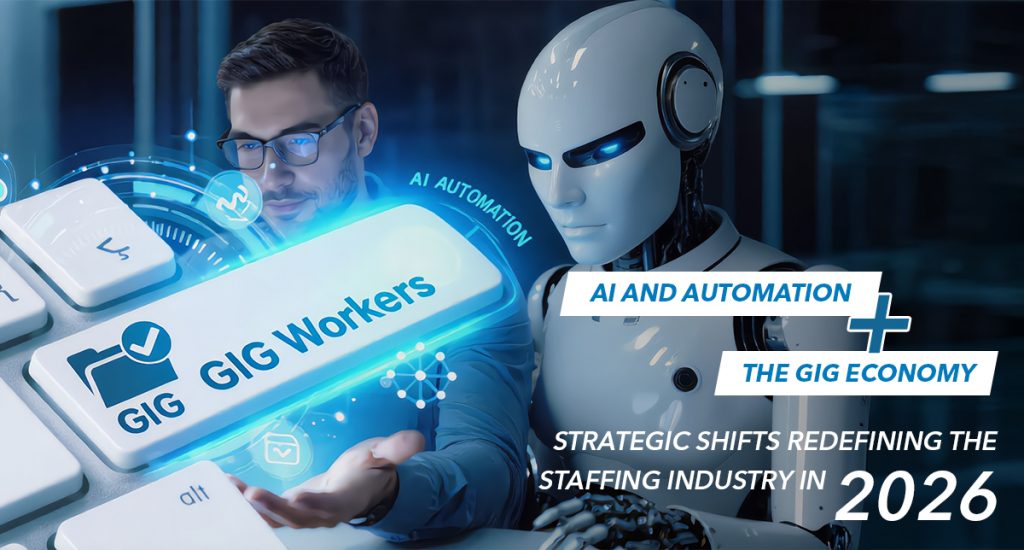
Megatrend #1: AI and Automation Are Redefining Value
Artificial Intelligence is no longer experimental in staffing—it’s operational. Most staffing firms are already using, or planning to use, AI to automate repetitive hiring tasks. But automation alone does not create advantage.
To move beyond surface-level efficiency, staffing firms must adopt AI with intent. As Angie College Hooper, Senior VP at Adecco, explains, success begins at the leadership level. Organizations must invest in AI literacy and rethink how work gets done—from client engagement to candidate sourcing and workforce management. Staffing firms that treat AI purely as a cost-reduction tool risk commoditizing their services. Those that lead will use AI to elevate human contribution, not eliminate it.
This means enabling recruiters to:
- Focus on relationship-building and career coaching
- Use AI analytics to anticipate talent shortages
- Engage clients in strategic workforce planning
At the same time, leaders must address AI’s risks. Without thoughtful design and human oversight, AI can unintentionally amplify bias and increase compliance exposure. The urgency is real. Industry data shows that 21% of large organizations have already replaced contingent workers with automation—and that number will continue to rise. Upskilling internal teams and refocusing on emerging roles is no longer optional.
Megatrend #2: The Gig Economy Is Reshaping Workforce Models
The rise of the gig economy represents one of the most significant shifts in how work gets done. Projections suggest that up to 50% of the U.S. workforce could participate in gig work by 2030. This evolution will create both winners and losers.
Traditional staffing models won’t disappear overnight—but firms that fail to adapt, particularly in the mid-market, will struggle. As Jason Leverant, President and COO of At Work, puts it: firms that don’t embrace workforce flexibility risk being left behind. Talent platforms are rapidly expanding their reach and now compete directly with staffing firms for control of the talent supply chain. However, staffing firms retain a critical advantage: trust, compliance expertise, and human insight.
Organizations with strong local presence and compliance credibility can offer pre-vetted freelance talent through digital marketplaces—reducing risk for clients while expanding service value. When supported by a hybrid delivery model, sales teams can move beyond order-taking to solution design—positioning staffing firms as strategic workforce partners, not transactional vendors.
Megatrend #3: Value-Added Services Are Breaking the Commodity Trap
Margin pressure is pushing staffing firms to rethink how they deliver value. Increasingly, forward-thinking leaders are moving away from time-and-materials models and toward outcome-driven solutions. This includes Statement of Work (SOW) engagements and project-based delivery models where billing is tied to defined milestones and results—not hourly rates.
As Michael Butts, CEO of Burtch Works, explains, this shift allows staffing firms to compete in spaces traditionally dominated by large consulting firms—while improving margin control and accessing a growing services market. Project-based models also enable smarter resource deployment—frontloading expertise early, then scaling down as deliverables are achieved—driving both efficiency and profitability.
That said, these models are not without risk. Success depends on clear scoping, disciplined contract structures, and careful cash flow management. But ignoring this shift altogether risks something far worse: irrelevance.
The Path Forward
The staffing industry has navigated disruption before—and it will do so again. But the firms that thrive in the years ahead will be those that:
- Use AI to enhance—not replace—human judgment
- Embrace workforce flexibility through hybrid talent models
- Expand beyond placements into strategic, value-driven services
At blueStone Solutions Group , we believe the future of staffing belongs to organizations that balance technology, trust, and strategy. The middle ground may be disappearing—but opportunity is growing for those ready to evolve.