
What if the hours you spend wrestling with payroll and complex financial models are the single biggest bottleneck holding your company back? It is a common struggle for ambitious leaders who find themselves trapped in the weeds while strategic decisions suffer from lagging data. You aren’t alone in this frustration. Recent research shows that only 6% of finance leaders feel they have the necessary headcount and skills to complete their priority projects for the year. Stop settling for reactive data that arrives too late to make a difference. At blueStone Solutions Group, we believe building a finance department should be treated as a meticulous architectural project where human alignment matters as much as technical proficiency.
This article provides your 2026 blueprint for transforming your financial function into a strategic growth engine that drives visionary success. You will learn the specific hiring sequence for your first five critical roles, how to balance in-house talent with specialized staffing partners, and the best ways to integrate AI for proactive insights. We will show you how to move beyond basic bookkeeping to create a department that anticipates challenges before they arrive.
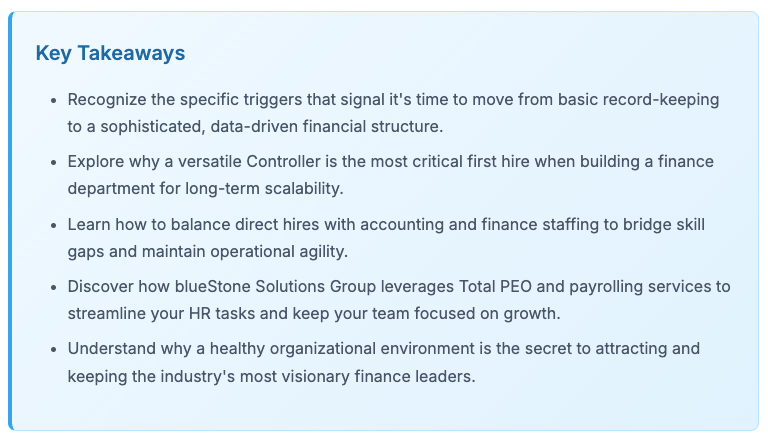
Table of Contents
- The Evolution of Finance: When and Why to Start Building
- Designing the Blueprint: Essential Roles and Modern Structure
- The Strategic Talent Mix: Hiring, Augmentation, and Outsourcing
- Future-Proofing Your Department: Culture and Partnership
The Evolution of Finance: When and Why to Start Building
The days of the finance department existing solely to “keep the lights on” are over. In 2026, the most successful companies treat their financial function as a strategic engine that powers every major executive decision. Building a finance department isn’t just about hiring a bookkeeper to track expenses; it’s about architecting a system that provides the clarity needed for visionary growth. At blueStone Solutions Group, we see this transition as a foundational moment for organizational health. It’s the point where you stop looking at what happened last month and start predicting what will happen next year. This shift requires a meticulous approach to talent and technology that many growing firms overlook until they hit a wall.
The Reactive vs. Proactive Finance Gap
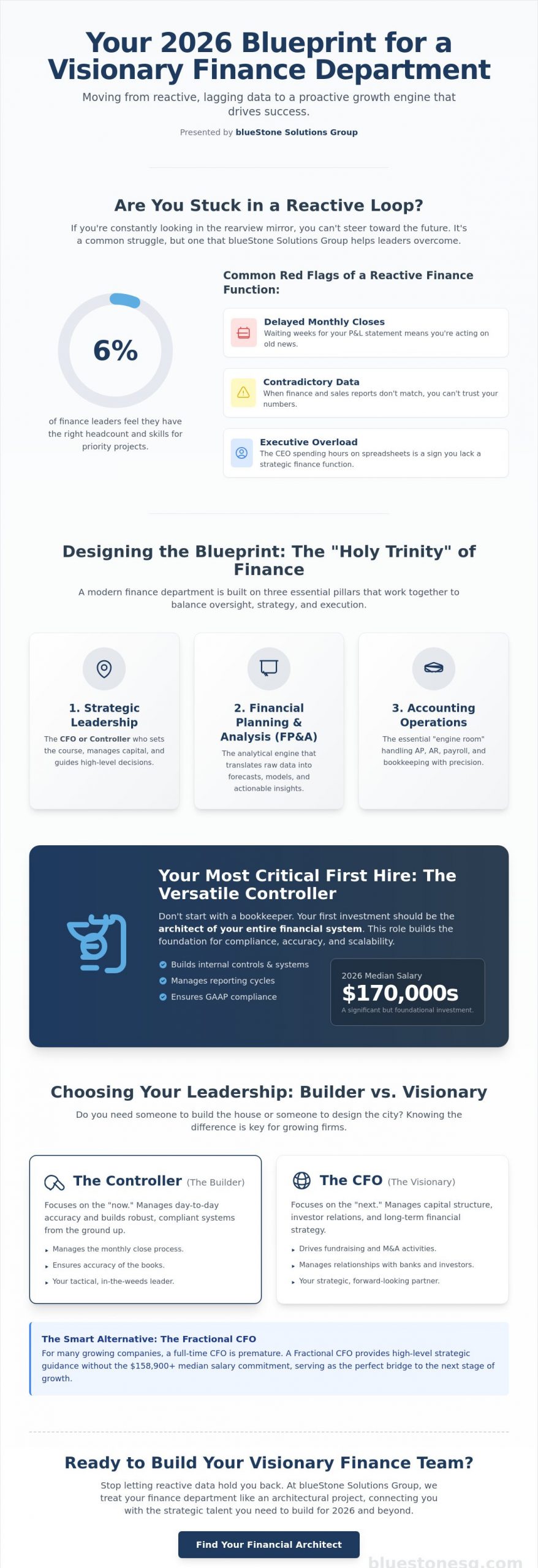
Are you still waiting 20 days after the month ends to see your profit and loss statement? That’s a classic sign you’re stuck in reactive mode. When you are in the process of building a finance department, the goal is real-time visibility. Consider these common red flags:
- Monthly closes that drag on for weeks.
- Financial data that contradicts your sales reports.
- The CEO spending hours on spreadsheet modeling instead of market expansion.
This level of insight is essential for enterprise-level scaling because it allows you to pivot before a minor leak becomes a sinking ship. Understanding how this fits into your broader Corporate Structure ensures that every department is aligned with your fiscal goals. A visionary partner helps bridge this gap by connecting you with strategic talent through specialized Accounting & Finance Staffing. We find that only 6% of leaders feel they have the right skills and headcount, making this transition a high-stakes challenge for any CEO.
The Cost of Delaying Your Finance Infrastructure
Delaying this build-out often leads to a “hidden tax” of poor financial modeling and mounting compliance risks. If you ever plan to fundraise or enter an M&A deal, clean data is your most valuable currency. Investors don’t just buy your revenue. They buy the reliability of your systems. Proactive planning ensures you stay ahead of 2026 GAAP updates, such as the new standards for credit losses and tax disclosures. Without a robust infrastructure, you’re essentially flying a jet with a broken altimeter.
The Complexity Tipping Point is the moment when manual processes threaten growth speed.
Designing the Blueprint: Essential Roles and Modern Structure
Building a finance department requires more than just filling seats; it’s about assembling a “Holy Trinity” of roles that balance oversight, strategy, and execution. Many leaders make the mistake of hiring for narrow, immediate needs like basic bookkeeping. Instead, you should aim for a hierarchy that supports long-term scalability. The core of a modern department consists of Strategic Leadership, Financial Planning and Analysis (FP&A), and Accounting Operations. By focusing on these three pillars, you ensure that your financial data flows upward to inform high-stakes decisions rather than getting trapped in a back-office silo.
The “First Hire” archetype is almost always a versatile Controller. This individual acts as the architect of your financial systems, setting up the internal controls and reporting cycles that keep the business compliant. With the median salary for a Controller sitting in the mid-$170,000s in 2026, this is a significant investment that requires a meticulous search for the right fit. At blueStone Solutions Group, we look beyond the resume to understand the “organizational environment” of your firm, ensuring your first hire has the grit to build from scratch and the vision to lead a growing team.
The Strategic Leadership: CFO vs. Controller
Do you need a visionary or a builder? A CFO focuses on the horizon, managing capital structure and investor relations, while a Controller manages the day-to-day accuracy of the books. For many growing firms, a full-time CFO might be premature. This is where a “Fractional CFO” serves as an ideal bridge, providing high-level guidance without the $158,900+ median manager salary commitment. When vetting these leaders, ask how they have used data to pivot a business strategy in the past. If you’re ready to find that perfect match, our Accounting & Finance Staffing experts can help you identify leaders who align with your long-term goals.
Operations and Analysis: The Engine Room
While the leadership sets the course, the engine room keeps the ship moving. This includes specialized roles in Accounts Payable, Accounts Receivable, and Payroll. However, the most critical addition for 2026 is the FP&A Manager. With 79% of FP&A teams now using AI for operational tasks, this role has shifted from manual data entry to strategic interpretation. You need someone who can manage your tech stack and provide the rolling forecasts that allow for agile reinvestment. By automating transactional labor, you can keep your headcount lean while maximizing the impact of every professional on your roster.
The Strategic Talent Mix: Hiring, Augmentation, and Outsourcing
Building a finance department doesn’t mean you have to hire every single person as a full-time employee on day one. In fact, trying to do so can lead to a rigid structure that is difficult to pivot when market conditions change. We recommend a “Hybrid Department” model for 2026. This approach keeps your core leadership in-house while using staff augmentation for specialized projects or high-volume transactional tasks. It gives you deep institutional knowledge at the top and incredible agility underneath. At blueStone Solutions Group, we provide the flexibility to scale your team up or down based on your real-time needs, ensuring you never carry more overhead than necessary.
When to Use Staff Augmentation
Sometimes you need a specific scalpel rather than a Swiss Army knife. Staff augmentation is ideal for high-impact, time-sensitive projects like ERP implementations, year-end audits, or covering maternity leave. With 61% of finance leaders reporting that finding skilled professionals is harder than it was just a year ago, the speed of a specialized partner is a major competitive advantage. You get the expertise you need immediately without the long-term commitment of a permanent hire. We ensure quality and cultural alignment by meticulously matching augmented team members to your specific organizational environment.
The Role of PEO and Payrolling in Finance
Your finance team should focus on high-level strategy, not chasing down tax IDs in five different states. Total PEO services offload this massive administrative burden, handling the complexities of benefits and multi-state compliance. This is especially vital for companies with distributed teams where payroll tax regulations change the moment you cross a state line. Using these services allows your internal team to remain lean and focused on visionary growth. Payrolling services reduce 1099/W2 misclassification risks by ensuring every contractor is properly categorized and compensated according to current labor laws.
If you are ready to streamline your operations and protect your bottom line, our Total PEO and Payrolling Services provide the safety net your growing department needs to thrive. By offloading the “paperwork” side of the business, you free your financial architects to build the future of the company.
Future-Proofing Your Department: Culture and Partnership
Success in finance is often measured in numbers, but the longevity of your department is measured in people. When you are building a finance department, you are creating a living culture that must sustain itself through economic shifts and internal scaling. At blueStone Solutions Group, we believe that the organizational environment is the most critical factor in retaining top-tier talent. If your team feels like they are simply processing transactions, they will eventually look for a role that offers more meaning. By fostering a sense of professional intimacy and partnership, you turn a back-office function into a visionary powerhouse that attracts the best in the field.
Building for Retention and Culture
Finance professionals often leave their roles when they feel their technical skills are being utilized but their strategic voices are being ignored. To keep your best people, you must move beyond a transactional relationship and create a mentor-like environment. This involves empowering your staff to provide proactive insights rather than just reactive reports. When your team members see themselves as architects of the company’s future, their commitment to long-term success deepens. High-level talent thrives when they are given the space to innovate within the framework of grounded reliability that we help you establish.
The WBE Advantage in Professional Staffing
Diversity in finance leadership isn’t just a metric; it is a strategic advantage that leads to better risk management and more creative problem-solving. Partnering with blueStone Solutions Group, a Certified Women’s Business Enterprise (WBE), allows you to meet your diversity spend requirements while gaining a unique perspective on specialized leadership. We understand that the ideal alignment between an individual and a company goes beyond a list of certifications. Our status as a woman-owned firm informs our meticulous approach to matchmaking, ensuring that every candidate we present through our Accounting & Finance Staffing services is prepared to contribute to a diverse and thriving workplace.
Your journey in building a finance department deserves a partner who is as committed to your vision as you are. We are ready to help you navigate the complexities of talent acquisition and structural design to ensure your firm is prepared for whatever 2026 and beyond may bring. Contact blueStone Solutions Group to start architecting your team and secure the strategic talent your business needs to flourish.
Traditional Staffing Agency vs Enterprise Workforce Partner
| Capability | Traditional Agency | blueStone Solutions Group |
|---|---|---|
| Technical Staffing | Resume sourcing | Specialized recruitment |
| Compliance Support | Limited | Integrated payroll + compliance |
| Workforce Planning | Reactive | Strategic infrastructure |
| Culture Alignment | Secondary | Core methodology |
| Enterprise Support | Transactional | Long-term partnership |
Architecting Your Financial Future
The transition from reactive record-keeping to proactive strategy is the defining moment for your company’s growth. By focusing on the “Holy Trinity” of roles and leveraging a hybrid model of talent, you ensure your infrastructure is as ambitious as your vision. Building a finance department is an ongoing process of refinement and alignment that requires a meticulous eye for both technical skill and cultural fit. You don’t have to navigate this complex execution alone.
At blueStone Solutions Group, we bring over 25 years of specialized recruitment expertise to your journey. As a Certified Women’s Business Enterprise (WBE), we utilize a human-centric “Matchmaker” approach to ensure every hire strengthens your unique organizational environment. We handle the intricacies of sourcing and vetting so you can focus on leading your business into its next chapter of success. Partner with blueStone Solutions Group for your finance staffing needs and let us help you turn your financial function into your greatest competitive advantage. You have the blueprint; now it’s time to build something truly extraordinary.
Frequently Asked Questions
What is the first role I should hire when building a finance department?
The first role you should hire is typically a versatile Controller who can establish your core systems and internal controls. This individual acts as the architect for your financial infrastructure; they ensure that your data is accurate and compliant from the start. While a CFO provides high-level vision, the Controller builds the engine that makes that vision possible. It’s a foundational step in building a finance department that scales with your ambition.
How much does it cost to build a full finance team in 2026?
Building a finance department in 2026 involves significant investment in specialized talent, with median salaries for a Controller in the mid-$170,000s and Financial Managers around $158,900. You’ll also need to account for Staff Accountants, who typically earn in the low-$60,000s. These figures reflect the high demand for skilled professionals who can navigate complex regulatory environments and advanced data analytics. Budgeting for these roles requires a clear understanding of your growth trajectory.
Should I use a staffing agency or hire directly for finance roles?
Most growing firms find the best results by using a hybrid approach that combines direct hires for core leadership with staffing partners for specialized projects. Direct hiring is ideal for long-term cultural alignment in senior roles. However, blueStone Solutions Group provides the agility you need through staff augmentation for high-impact tasks like audits or ERP migrations. This allows you to scale quickly without the burden of permanent overhead for temporary needs.
What is the difference between accounting and a finance department?
Accounting focuses on the accurate recording of past transactions and regulatory compliance, while the finance department uses that data to plan for future growth. Think of accounting as the foundation of historical truth and finance as the strategic engine that drives investment and scenario planning. Both are essential for a healthy organizational environment that values both precision and vision. Integrating these functions ensures your business remains both grounded and forward-thinking.
How does a PEO help a growing finance department?
A PEO helps by offloading the administrative weight of payroll, benefits, and multi-state tax compliance from your internal finance team. This is particularly valuable for lean departments that need to focus on strategic growth rather than paperwork. By utilizing Total PEO services from blueStone Solutions Group, you ensure your team spends their time on high-value analysis. It streamlines operations and reduces the risk of costly misclassification errors.
What technical skills are most important for finance hires in 2026?
The most important technical skills for 2026 include proficiency in AI-powered automation tools and advanced data analytics for real-time reporting. Since 79% of FP&A teams are now using AI for operational tasks, hires must be comfortable leveraging technology to drive strategic insights. Upskilling in these areas is crucial as the industry shifts away from manual data entry toward proactive financial modeling. Candidates who can bridge the gap between tech and strategy are in high demand.