
The most popular PEO pricing model might be the very thing quietly draining your scaling budget. While a percentage-of-payroll structure seems simple, it often creates “hidden” markups that penalize you for hiring top-tier technical talent. At blueStone Solutions Group, we believe your HR costs should be as precise and predictable as your own engineering roadmaps. Having PEO pricing models explained through a strategic lens is the first step toward a more sustainable growth strategy in 2026.
It’s natural to feel frustrated when you can’t pin down a consistent monthly spend while your team expands. You want to build a culture of excellence, not spend your weekends auditing complex administrative fees or worrying about cost spikes during rapid scaling. This guide provides a clear mathematical framework to compare flat-fee versus percentage models. We’ll show you why businesses partnering with a PEO see an average annual ROI of 27.2% in cost savings alone. You’ll gain the confidence to choose a partner that understands the nuances of technical staffing and keeps your professional intimacy intact as you grow.
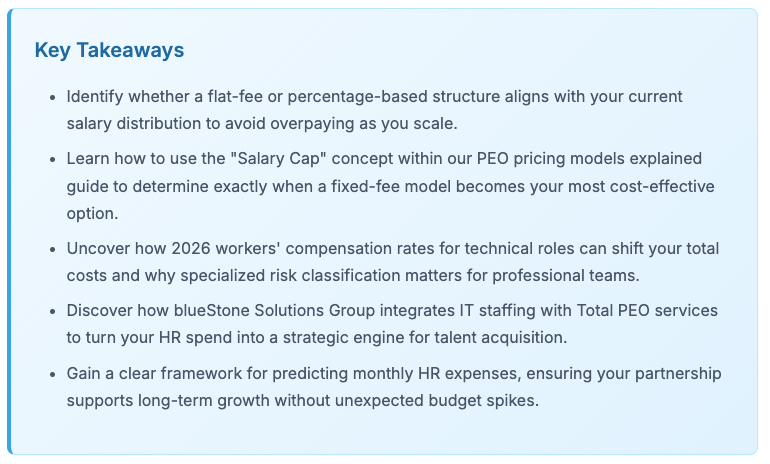
Table of Contents
- Decoding the PEO Pricing Landscape: Why One Size Does Not Fit All
- Fixed Fee vs. Percentage of Payroll: The Mechanics of PEO Costs
- Calculating the Real ROI: Factors That Shift Your PEO Math
- Beyond the Invoice: How blueStone Solutions Group Delivers Total PEO Value
Decoding the PEO Pricing Landscape: Why One Size Does Not Fit All
Think of your PEO partnership as the architectural foundation of your business. It’s not just a line item on a ledger; it’s the cost of securing high-level HR expertise, enterprise-grade benefits, and ironclad compliance. When we look at how a Professional Employer Organization (PEO) operates, the value lies in co-employment. This model allows you to leverage economies of scale that were once reserved for massive corporations. At blueStone Solutions Group, we don’t see these costs as a burden. We view them as a strategic catalyst for your growth. The clear framework for PEO pricing models explained in this guide helps you move from reactive spending to visionary planning.
The industry generally relies on two primary standards: the fixed per-employee-per-month fee and the percentage of gross payroll. Each carries its own logic and long-term implications for your bottom line. Choosing correctly requires an honest look at your current team size and your hiring trajectory for the coming year.
The Core Components of Your PEO Invoice
Your monthly invoice usually splits into two distinct categories. First, you have pass-through costs, which include state and federal taxes, workers’ compensation, and health insurance premiums. Second, there is the administrative fee. The administrative fee is the PEO’s actual revenue for managing your human capital. blueStone Solutions Group prioritizes radical transparency here. We ensure every dollar is accounted for so you never feel like you’re paying for “mystery” services or hidden markups.
Strategic Alignment: Matching Model to Mission
A fast-moving tech startup with five developers has vastly different needs than a legacy engineering firm with fifty staffers. From our “Visionary Architect” perspective, your pricing model must mirror your mission. If you’re scaling rapidly, a model that feels like an “extra cost” today might actually be the insurance policy that prevents a million-dollar compliance error tomorrow. It’s about shifting the narrative from “What does this cost?” to “What does this enable?”
We often hear the objection that outsourcing is just an added expense. However, when you factor in the time saved on payroll administration and the lower insurance premiums gained through co-employment, the math often tells a different story. It’s not just about spending; it’s about investing in an organizational environment where your talent can thrive without administrative friction.
Fixed Fee vs. Percentage of Payroll: The Mechanics of PEO Costs
The choice between a fixed fee and a percentage-based model isn’t just about accounting; it’s about how you value your team’s growth. Understanding the mechanics of these PEO pricing models explained through a strategic lens allows you to align your HR spend with your long-term vision. At blueStone Solutions Group, we help you navigate these structures to ensure your capital is fueling innovation rather than getting lost in administrative complexity.
In 2026, we see a distinct shift in how companies approach their service agreements. The market is moving toward a choice between “bundled” services, where every HR feature is included in one fee, and “unbundled” approaches that allow for more surgical customization. This flexibility is vital for firms that want to pay only for the high-impact tools they actually use.
The PEPM Model: Predictability for High Earners
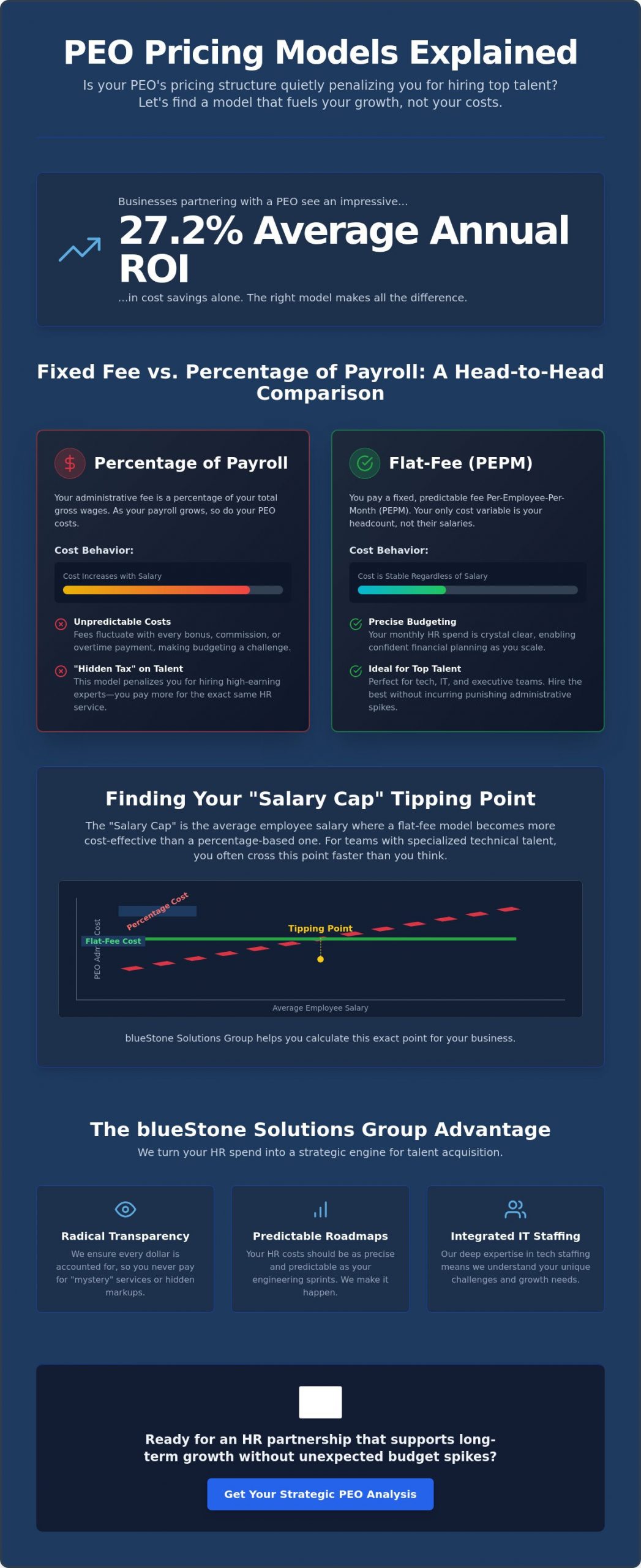
The Per-Employee-Per-Month (PEPM) model is often considered the gold standard for organizations focused on IT and executive staffing. It offers a flat, predictable fee for every team member regardless of their salary. This simplicity makes budgeting effortless since your headcount is the only variable that shifts your cost. For companies utilizing IT project solutions, this model ensures that bringing on high-level experts doesn’t result in a punishing administrative spike. General research into PEO costs and considerations suggests that while PEPM ranges can vary across the industry, the stability they provide for high-earning professional teams is unmatched.
Percentage of Payroll: Pros and Cons of Variable Billing
In contrast, the percentage of payroll model ties your administrative fee directly to gross wages. This means your costs fluctuate every time you issue a bonus, pay out overtime, or award a commission. While this can be beneficial for small teams with high turnover in entry roles, it often acts as an unintended tax on high-performing employees. As your technical talent earns more, you pay more for the same level of HR service. This model only truly makes sense when your payroll is consistently low and scaling isn’t your immediate priority.
blueStone Solutions Group works closely with our partners to audit these models annually. We believe your billing should evolve as your company matures. If you’re looking for a partner that treats your workforce like a masterpiece of engineering, it might be time to explore how our Total PEO solutions can refine your financial strategy. We ensure your billing model supports your mission, not just your payroll cycle.
Calculating the Real ROI: Factors That Shift Your PEO Math
Mastering your HR budget requires looking beyond the sticker price. While we have already reviewed the basic PEO pricing models explained in earlier sections, calculating true ROI involves understanding the variables that shift the math as you scale. At blueStone Solutions Group, we focus on the specific needs of technical and professional teams where high salaries and multi-state footprints are the norm. Your PEO partner should be a meticulous architect of your organizational environment, not just a processor of transactions.
In 2026, workers’ compensation rates for technical roles are shifting based on new risk classifications for remote and hybrid work. Managing these nuances across multiple states adds a layer of complexity that can drain your internal resources. With SUTA wage bases varying wildly across the country, an unmanaged payroll can lead to costly errors. blueStone Solutions Group manages this meticulous execution for you. We ensure your multi-state compliance is seamless, allowing you to focus on your long-term strategic planning.
The High-Salary Trap in Percentage Models
A 3% administrative fee on a $150,000 engineer costs you $4,500 every single year. When you compare this to a standard PEPM fee, the delta is often massive. This “High-Salary Trap” is why we often recommend a “Salary Cap” for percentage models or a transition to fixed-fee structures. You shouldn’t be penalized for hiring the best talent in the industry. Identifying the point where a fixed fee becomes cheaper than a percentage is a vital step in maintaining a predictable monthly HR spend.
Hidden Costs and “Value-Adds” to Watch For
Transparency is the cornerstone of a healthy partnership. Some providers hide setup costs, termination fees, or surcharges for custom reporting in the fine print. Our Total PEO services at blueStone Solutions Group eliminate these surprises by providing a clear, all-in framework. Beyond the invoice, consider the ROI of “Soft Costs.” Research from the industry shows that PEO clients experience 12% lower employee turnover. When you combine that with superior candidate vetting for engineering staffing, the value of your PEO partner far exceeds the administrative fee. Businesses using a PEO see an average annual ROI of 27.2% in cost savings alone, proving that the right model is a growth engine, not a drain.
If you’re ready to see how your specific headcount and salary distribution impact your bottom line, you can explore our Total PEO solutions to see how we align your HR spend with your growth velocity.
Beyond the Invoice: How blueStone Solutions Group Delivers Total PEO Value
Choosing a partner based solely on a spreadsheet is like judging a building’s integrity by its paint color. While we have already seen PEO pricing models explained through the lens of fees and percentages, the true value of a partnership lies in its ability to act as a strategic staffing engine. At blueStone Solutions Group, we believe your HR infrastructure should be as ambitious as your business goals. We don’t just process payroll; we architect an organizational environment where technical talent feels supported and empowered to innovate.
Our status as a WBE-certified partner adds another layer of strategic value to your choice. For many of our clients, this certification helps meet corporate diversity spend requirements while gaining access to top-tier IT staffing and IT consulting expertise. It’s a way to align your operational needs with your commitment to leadership diversity without compromising on technical proficiency or meticulous execution.
The Synergy of Staffing and PEO
Most providers stop at the “hire” button. blueStone Solutions Group creates a seamless lifecycle by integrating our IT staffing and engineering staffing capabilities directly with our Total PEO services. We find the talent, vet them for cultural and technical alignment, and then manage the complex HR requirements that follow. This creates a level of professional intimacy that traditional vendors simply can’t match. By having one partner manage the entire talent journey, you significantly reduce the friction that often leads to a “bad hire” or early turnover. You aren’t just buying a service; you’re investing in a mentorship-style relationship that treats your growth as our own.
Your 2026 Growth Roadmap
Transitioning to a more efficient pricing model doesn’t have to be a disruptive event. It should be a logical step in your company’s expansion. If you’re currently feeling the weight of unpredictable costs or “hidden” fees, use this final checklist to vet your current or future PEO contracts:
- Audit Salary Caps: Ensure your percentage-based model includes a cap for high earners to avoid the “high-salary trap.”
- Verify Risk Codes: Check that your workers’ compensation classifications accurately reflect your technical or remote workforce.
- Demand Transparency: Look for a clear breakdown between administrative revenue and pass-through taxes or insurance.
- Assess Integration: Determine if your partner can scale from simple payrolling services to full-scale IT project solutions as your needs evolve.
We invite you to move beyond the transaction. Instead of just requesting a quote, let’s engage in a Strategic Workforce Audit to see how your current model stacks up against your 2026 roadmap. Let blueStone Solutions Group architect your custom PEO solution.
Architect Your Future Workforce Today
Your growth strategy deserves a financial foundation that is as meticulous as your engineering projects. You now understand how to navigate the “high-salary trap” and why predictable flat-fee models often outperform variable percentages for scaling technical teams. By aligning your billing structure with your long-term vision, you transform HR from a cost center into a strategic catalyst. With the nuances of PEO pricing models explained, you have the clarity to choose a partner that truly understands the artistic and incremental nature of technical labor.
At blueStone Solutions Group, we bring over 25 years of enterprise professional services experience to every partnership. As a certified Women’s Business Enterprise (WBE) with deep roots in IT and engineering staffing, we offer more than just administrative support; we provide a visionary approach to workforce planning. We’re here to help you build an organizational environment where your talent can thrive without the friction of hidden costs or complex compliance mandates.
Ready to optimize your HR spend? Connect with blueStone Solutions Group for a custom PEO analysis.
The right partnership is waiting to help you scale with confidence and precision. Let’s start building your 2026 roadmap together.
Frequently Asked Questions
What is the average PEO administrative fee in 2026?
Administrative fees typically vary based on your headcount and the complexity of your compliance needs. In 2026, most providers offer a choice between a fixed monthly fee per employee or a percentage of your total gross payroll. Since blueStone Solutions Group focuses on high-level professional teams, we prioritize transparency in these line items. This ensures you aren’t paying for unused features while your administrative costs remain predictable as you scale.
Is a percentage-of-payroll model or a flat PEPM fee better for IT companies?
A flat PEPM fee is generally superior for IT companies due to the high salary distribution of technical roles. When your average wages exceed certain industry thresholds, percentage-based models can act as a “tax” on your top talent. By choosing a fixed fee, you decouple your HR costs from your employees’ raises and bonuses. This allows your budget to remain stable even as you hire senior engineers or issue performance-based rewards.
Do PEO pricing models include workers’ compensation and SUI taxes?
Most PEO pricing models separate the administrative fee from pass-through costs like workers’ compensation and State Unemployment Insurance (SUI). While the PEO manages the reporting and payments, these specific taxes and insurance premiums are typically billed based on actual usage and state-mandated rates. blueStone Solutions Group provides a clear breakdown of these items to ensure you understand exactly which portion of your invoice covers service and which covers statutory requirements.
Can I switch PEO pricing models after the contract has started?
Switching models is often possible during key milestones like your annual renewal or during periods of rapid team expansion. We encourage our partners to treat their HR structure as a living roadmap that evolves with their business. blueStone Solutions Group performs annual audits to ensure your current billing structure still aligns with your hiring velocity. If your salary distribution shifts, we work with you to transition to a more cost-effective framework.
Are there hidden setup or implementation fees with blueStone Solutions Group?
We believe in radical transparency and aim to eliminate the “surprise” fees often found in traditional vendor contracts. While some industry providers charge for setup or custom reporting, blueStone Solutions Group focuses on a holistic Total PEO approach. We discuss all implementation requirements during our initial Strategic Workforce Audit. This ensures your team is onboarded smoothly without hidden surcharges, allowing you to focus on your long-term growth and organizational health.
How does a PEO pricing model impact employee benefit costs?
Your choice of structure doesn’t change the underlying benefit premiums, but it does change how you manage the total cost of employment. With PEO pricing models explained through the lens of co-employment, you gain access to enterprise-grade benefits at a lower cost than a small business could secure alone. The administrative model you choose simply determines how you pay for the management of those benefits, ensuring your professional team receives top-tier care.