

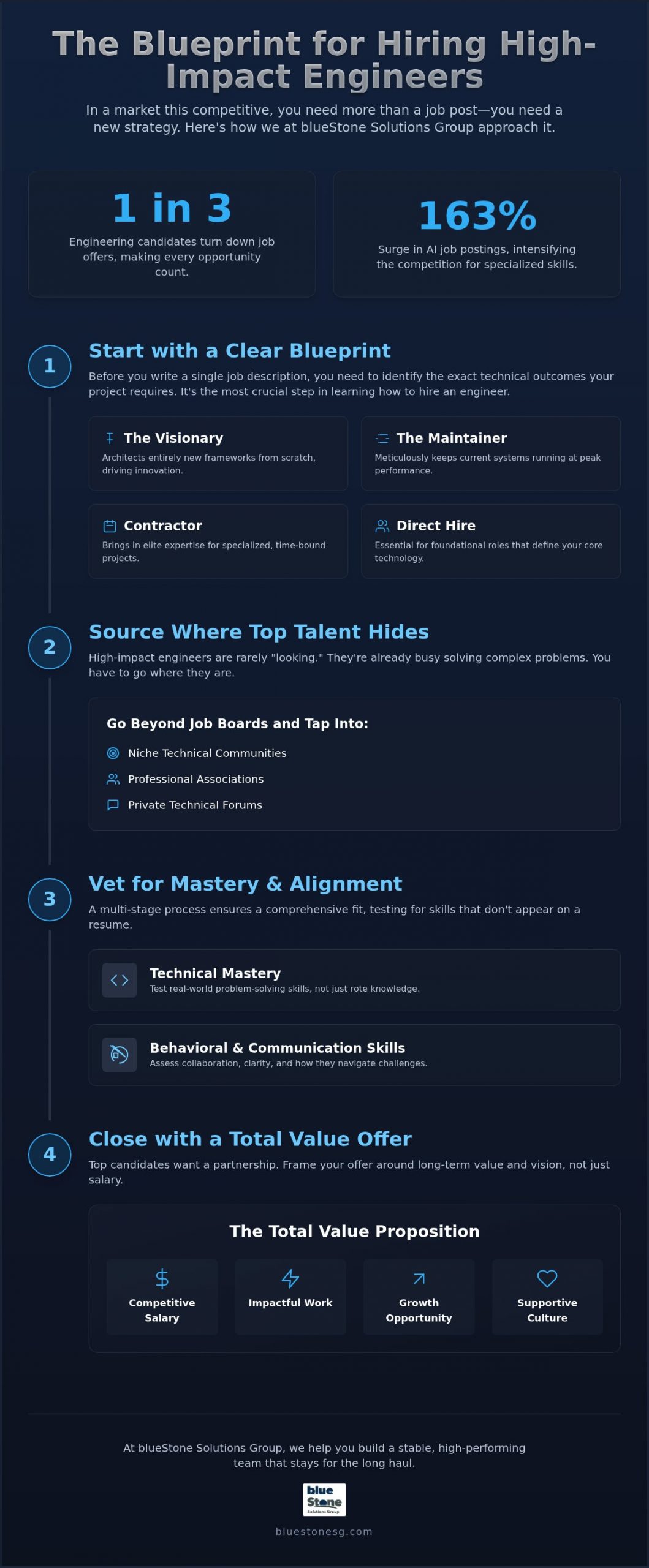
Did you know that nearly one in three engineering candidates who receive a job offer will ultimately turn it down? In a market where AI job postings have surged by 163 percent, the competition for talent is no longer just about offering the highest salary. You’ve likely felt the sting of a long time-to-hire slowing down your most ambitious projects, or the frustration of high turnover once you finally find a match. At blueStone Solutions Group, we believe that learning how to hire an engineer shouldn’t feel like a gamble against project deadlines and rising industry demands.
We understand that you’re looking for more than just a list of technical skills; you want a visionary partner who truly fits your culture. This guide offers a comprehensive framework for finding, vetting, and closing high-impact talent without the usual friction. We will walk you through a streamlined recruitment process that prioritizes skills-based hiring and human-centric values. By the end of this article, you’ll have the blueprint needed to build a stable, high-performing team that stays for the long haul.
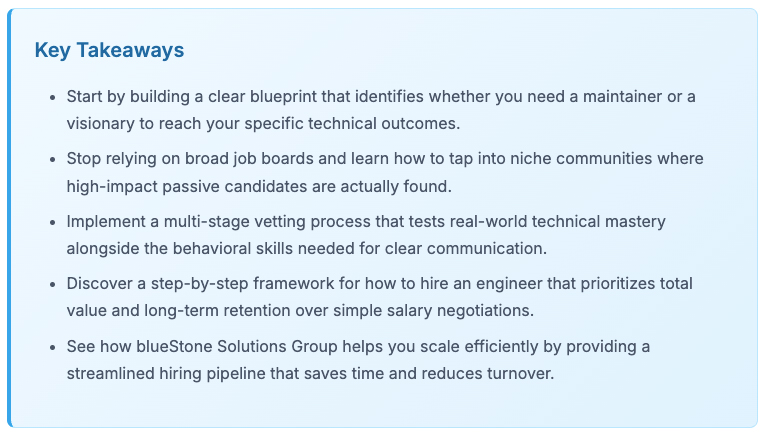
Table of Contents
- Defining Your Engineering Needs: The Blueprint for Success
- Sourcing Technical Talent: Where High-Impact Engineers Actually Live
- The Interview Blueprint: Vetting for Mastery and Alignment
- Closing the Deal and Scaling with blueStone Solutions Group
Defining Your Engineering Needs: The Blueprint for Success
Hiring is like any other major build; it requires a solid blueprint before you break ground. When you’re looking at how to hire an engineer, the first step isn’t posting a job description. It’s identifying the specific technical outcomes your project needs to survive and thrive in 2026. Are you looking for a “Maintainer” who can meticulously keep your current systems running at peak performance, or do you need a “Visionary” capable of architecting entirely new frameworks from scratch?
Be honest about your technical debt. If your codebase or infrastructure is cluttered with legacy issues, hiring a high-level architect without giving them the resources to clean house is a recipe for turnover. A high-impact engineer is a professional who balances technical execution with strategic growth. Understanding where your project stands today ensures you don’t hire over-qualified talent for routine tasks or under-qualified talent for a massive rebuild.
Contractor vs. Direct Hire: Which Model Fits?
Think about the scope. If you’re facing a specialized, time-bound sprint in aerospace or project engineering, staff augmentation is often the smartest move. This allows you to bring in elite expertise without the long-term overhead of a permanent role. However, for roles that define your foundational technology, a permanent direct hire is essential. At blueStone Solutions Group, we help leaders navigate this choice by looking at the project’s lifespan and the depth of the organizational environment needed to succeed.
Mapping Technical Requirements to Business Goals
Your 2026 product roadmap should dictate your hiring needs. Don’t just list every skill under the sun. Distinguish between “must-have” certifications, like a PE license or specific CAD expertise, and “nice-to-have” skills that can be learned on the job. This clarity streamlines the recruitment process and sets clear expectations. Define what success looks like in the first 90 days. When both parties know exactly how performance is measured, you build a foundation of trust from day one, ensuring you truly master how to hire an engineer for the long term.
Sourcing Technical Talent: Where High-Impact Engineers Actually Live
If you’re only posting on LinkedIn and waiting for applications to roll in, you’re likely missing the top 10 percent of engineering talent. High-impact engineers are rarely “looking” for work; they’re already busy solving complex problems elsewhere. To truly master how to hire an engineer in 2026, you have to go where they live. This means diving into specialized niche communities, professional associations, and private technical forums rather than casting a wide net on broad job boards that often lead to low-quality candidate pools.
At blueStone Solutions Group, we take a “Visionary Architect” approach to sourcing. We don’t just scan resumes for keywords; we build relationships with passive candidates who aren’t on the open market. Top talent values innovation and a supportive organizational environment. If your employer branding doesn’t highlight your commitment to culture and technical growth, these elite professionals won’t even pick up the phone. They want to know their work will have a lasting impact.
The Power of Specialized Recruiting Networks
Generalist recruiters often struggle to tell the difference between a mid-level coder and a true architectural leader. They might get the buzzwords right, but they miss the nuance of specialized engineering disciplines. A technical recruiter acts as a thoughtful matchmaker, aligning a candidate’s personal career trajectory with your company’s long-term strategic goals. If you want to see how we bridge this gap, explore our Engineering Staffing Services: Finding Specialized Talent.
Leveraging Diversity and WBE Partnerships
Diversity isn’t just a metric; it’s a massive competitive advantage. Partnering with a WBE-certified firm like blueStone Solutions Group helps you meet diversity spend goals while bringing fresh, innovative perspectives to your technical team. Diverse engineering teams are demonstrably better at problem-solving because they approach challenges from multiple angles. When you prioritize an inclusive organizational environment, you naturally attract talent that values social responsibility alongside technical excellence.
Finding the right fit requires more than just a search engine. When you’re ready to move beyond the usual suspects, exploring our engineering staffing solutions can give you the proactive edge needed to find that needle in the haystack.
The Interview Blueprint: Vetting for Mastery and Alignment
Resumes are historical documents; they rarely predict future performance. If you want to master how to hire an engineer, move beyond the paper and into the practice. In 2026, the most effective vetting processes are designed as collaborative sessions rather than high-pressure interrogations. This shift in perspective allows you to see how a candidate thinks, communicates, and solves problems in real-time. It’s about finding a partner, not just a pair of hands. The best interview process feels like a collaboration, not an interrogation.
Designing the Technical Assessment
Stop using abstract puzzles that have nothing to do with your daily operations. The “whiteboard trap” often alienates top-tier talent who prefer solving actual architectural challenges. Instead, implement take-home projects or pair-programming sessions that mirror the technical debt or feature builds your team currently faces. Focus on their problem-solving logic rather than just memorized syntax. Involving your senior engineers in this phase is vital. It builds peer-level respect and ensures the candidate’s logic aligns with your existing standards.
Assessing Organizational Environment Fit
Technical mastery is only half the battle. You need to know how a candidate handles the friction of a growing business. Ask situational questions that dig into how they manage project scope creep or conflicting priorities. At blueStone Solutions Group, we emphasize that a candidate’s preferred working style, whether remote or hybrid, must align with your infrastructure to ensure long-term retention. Look for individuals who are not just looking for a job, but who are hungry for personal growth and aligned with your firm’s visionary goals. A great hire understands that how to hire an engineer is as much about cultural alignment as it is about code.
If your current interview process is failing to surface the right matches, it might be time for a more meticulous approach. Let us help you refine your strategy. You can start by exploring our engineering staffing solutions to find talent that fits both your tech stack and your culture.
Closing the Deal and Scaling with blueStone Solutions Group
The offer stage is where your strategic blueprint finally comes to life. It’s a partnership negotiation, not a simple transaction. When you’ve found the right talent, the conversation should shift from “what can you do for us” to “what can we build together.” In a market where offer acceptance rates hover around 70 percent, closing the deal requires a focus on total value that goes far beyond a base salary. High-impact engineers in 2026 are looking for professional intimacy and a deep investment in their personal growth.
You might wonder if a professional staffing partner is worth the investment. Address the objection directly: a bad internal hire is significantly more expensive than the fee for a meticulously vetted professional. Between the time spent by hiring managers and the lost productivity of a role that stays open for 6 to 10 weeks, the hidden costs of a failed search can stall your entire roadmap. At blueStone Solutions Group, we handle the complex execution of the search so you can stay focused on your company’s overarching architecture.
Making an Irresistible Offer
To win over elite talent, you must highlight professional development opportunities and high-impact project ownership. Engineers want to know they’ll have the autonomy to solve meaningful problems. It’s also vital to ensure your compensation packages are aligned with the latest Engineering Compensation Trends: 2026. Beyond the numbers, communicate your long-term vision. When a candidate sees how their work contributes to a forward-thinking progress, they don’t just sign a contract; they commit to your mission.
Why Partner with blueStone Solutions Group?
Scaling a team requires more than just finding names; it requires a visionary partner who understands the nuances of technical labor. Our meticulous vetting process ensures you only meet candidates who are a perfect match for your organizational environment. As a certified Women’s Business Enterprise (WBE), blueStone Solutions Group also helps you meet diversity spend goals while fostering an inclusive culture that attracts top-tier talent.
We further streamline your growth through our Total PEO and payrolling services, removing the administrative burden that often slows down expansion. We act as your mentor and architect in the hiring space, ensuring every new addition strengthens your foundation. If you’re ready to master how to hire an engineer and build a team that lasts, contact blueStone Solutions Group to start building your engineering dream team today.
Common Questions About Technical Recruitment
What is the average time to hire an engineer in 2026?
Expect the process to take between 6 and 10 weeks from the initial job posting to a signed offer. This timeline includes the stages of sourcing, multiple interview rounds, and technical assessments. Once the offer is signed, it usually takes an additional 2 to 4 weeks before the new hire actually starts. At blueStone Solutions Group, we focus on reducing this window by maintaining a proactive network of pre-vetted talent so your projects don’t lose momentum.
Should I use a staffing agency or hire an engineer directly?
The choice depends on your internal resources and the urgency of the role. If your HR team lacks technical expertise or the bandwidth to source passive candidates, a specialized agency is often more efficient. Partnering with blueStone Solutions Group gives you access to the top 10 percent of talent that isn’t actively looking on job boards. This approach ensures you find a visionary architect who fits your organizational environment rather than just a quick fix for a vacant seat.
How do I vet an engineer if I am not technical myself?
Focus on problem-solving logic and behavioral alignment while delegating the technical deep dive to trusted experts. You can involve your current senior engineers to lead the peer-review portion of the interview or use a specialized staffing partner to handle the heavy lifting of technical vetting. This is a vital part of how to hire an engineer without getting overwhelmed by buzzwords; it ensures the candidate can actually communicate complex ideas to non-technical stakeholders.
What are the most in-demand engineering skills this year?
AI and machine learning expertise are currently the most sought-after skills, with job postings for these roles surging by 163 percent over the last year. There is also a massive demand for engineers proficient in automation, robotics, and AI-driven systems. We’ve seen that the most successful candidates in 2026 are those who can integrate these emerging technologies into traditional engineering frameworks to drive strategic growth for their organizations.
How much does it cost to hire an engineer through a staffing firm?
Most technical recruitment firms operate on a contingency or retained basis, with fees typically calculated as a percentage of the candidate’s first-year base salary. These fees often fall between 20 and 30 percent depending on the seniority and specialization of the role. While there’s an upfront cost, it’s designed to prevent the much higher expense of a bad hire or a critical position remaining open for months. blueStone Solutions Group works with you to find a model that fits your specific project goals.
What is the difference between staff augmentation and a direct hire?
Staff augmentation is a flexible model where you bring in specialized talent for specific project sprints or time-bound needs without adding to your permanent headcount. A direct hire is a long-term addition to your team meant to build and sustain your core technical foundation. Both are essential strategies when you’re looking at how to hire an engineer, and we often help clients use a mix of both to maintain agility while scaling their internal architecture.