
The real expense of your next software engineer isn’t the recruiter’s fee; it is the “Technical Vetting Tax” paid by your most expensive internal developers. When your senior architects spend twenty hours a week screening candidates instead of building products, your project timelines suffer. At blueStone Solutions Group, we’ve seen how these invisible drains turn a standard recruitment drive into a budget crisis. Mastering the art of calculating the total cost of an IT hire is the only way to protect your 2026 margins.
You likely already know that a bad hire can cost you up to 200% of an annual salary, but the daily friction of a slow, inefficient process is just as damaging. We’re going to help you unlock the full picture of your recruitment spend by uncovering the hidden internal and external costs of technical hiring. This guide provides a clear roadmap for creating a defensible 2026 budget, lowering your cost-per-hire, and identifying exactly when to leverage staff augmentation to keep your team focused on innovation.
Table of Contents
- Beyond the Salary: Why Calculating IT Hiring Costs is Different
- The Invisible Drain: Technical Vetting and Opportunity Costs
- The Master Formula for IT Recruitment ROI
- Strategic Cost Optimization with blueStone Solutions Group
Beyond the Salary: Why Calculating IT Hiring Costs is Different
Hiring a new developer isn’t just a transaction; it’s an investment in your company’s digital architecture. Most managers focus on the base salary, but that’s like looking at the price of a car without considering insurance, fuel, or maintenance. When calculating the total cost of an IT hire, you have to account for every resource spent from the initial outreach to the final onboarding. At blueStone Solutions Group, we believe this process should be viewed as a strategic investment rather than just another line-item expense on your quarterly report.
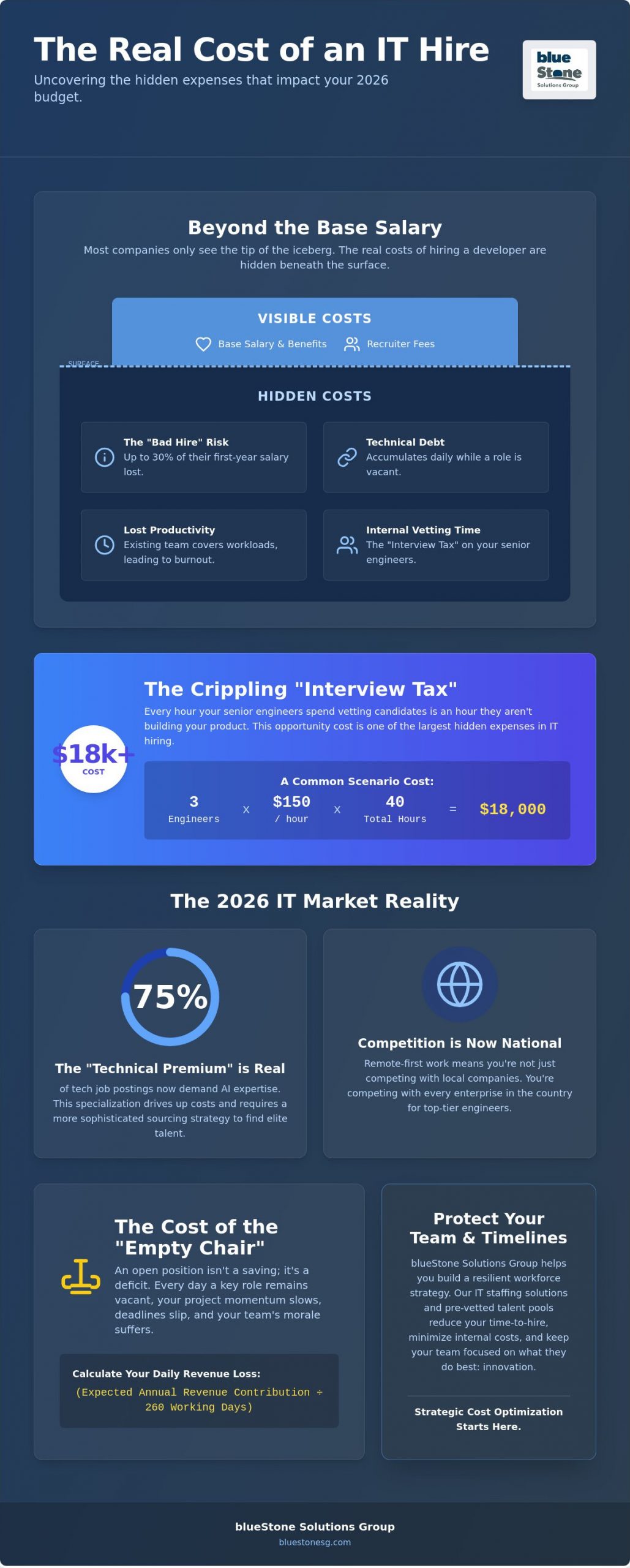
The 2026 market has introduced a “Technical Premium” that didn’t exist a few years ago. With 75% of tech job postings now requiring AI expertise, the hunt for talent is more specialized and expensive. You aren’t just paying for a set of hands; you’re paying for the “Time-to-Impact.” This metric measures how long it takes for a new hire to actually start generating value for the team. If your recruitment process is slow, that “Time-to-Impact” stretches out, costing you thousands in lost productivity and missed deadlines.
External vs. Internal Recruitment Costs
Visible costs are easy to track. You know exactly what you’re paying for a LinkedIn post, which can cost between $350 and $700, or a developer-specific ad on Stack Overflow. However, 2026 has brought new external layers, such as subscriptions to AI-driven sourcing tools that help filter the flood of AI-generated resumes. Internal costs are harder to pin down. These include the hours HR spends on initial screenings and the software stack used to manage the pipeline. Don’t forget employee referral bonuses; they’re a great way to find talent, but they still hit the bottom line.
The 2026 IT Market Reality
Finding an AI Architect or a Cloud Security Engineer is a different beast than hiring a generalist. These specialized roles often require a national search because remote-first work has leveled the playing field. You’re no longer just competing with the company down the street; you’re competing with every enterprise in the country. This competition drives up sourcing costs and requires a more sophisticated approach. blueStone Solutions Group leverages an extensive national network to bridge this gap, helping you find high-impact talent without the friction of a localized search. This strategic reach ensures you don’t overpay for talent while maintaining the high standards your projects demand.
The Invisible Drain: Technical Vetting and Opportunity Costs
The real financial leak often happens inside your own office walls. While you’re busy calculating the total cost of an IT hire, you might miss the “Interview Tax” being paid by your most valuable assets. When a senior architect spends ten hours a week reviewing code challenges from candidates instead of building your product, you aren’t just paying for their time. You’re paying for the delay in your product roadmap. According to the U.S. Department of Labor, the cost of a bad hire can reach 30% of their first-year earnings. However, the cost of the vetting process itself often goes unmeasured.
The True Hourly Rate of a Technical Interview
To find the actual price of your recruitment funnel, use this simple math: (Senior Engineer Hourly Rate x Number of Interviewers) x Total Interview Hours. If you have three engineers earning $150 per hour sitting in on four rounds of interviews for ten different candidates, the vetting cost alone exceeds $18,000. This doesn’t include the time spent on technical assessments or debrief meetings. At blueStone Solutions Group, we recommend streamlining this process by using pre-vetted talent pools. This approach maintains a high talent bar while protecting your team’s focus.
The Cost of the “Empty Chair”
An open position isn’t a savings; it’s a deficit. When a key technical role remains vacant for 60 days or more, “Technical Debt” begins to accumulate. Your existing team must pivot to cover the missing specialist’s workload. This leads to burnout, lower morale, and eventually, more turnover. If the role is revenue-generating, you can calculate the daily loss by dividing the expected annual revenue contribution by 260 working days.
Speed-to-hire is a critical cost-saving metric that many managers overlook. Every day a chair stays empty, your project momentum slows and deployment deadlines slip. If you find your internal pipeline is stalled, considering IT staffing solutions can help you fill these high-impact roles in days rather than months. This proactive strategy ensures your current team stays energized and your visionary goals remain on track.
The Master Formula for IT Recruitment ROI
Stop thinking of recruitment as a simple cost center. Instead, view it through the lens of Recruitment ROI; this is the long-term value a candidate brings to your organization minus the total acquisition cost. When you are calculating the total cost of an IT hire, a basic salary multiplier is no longer sufficient. In 2026, your formula must account for the specialized benefits that top-tier talent now expects. High-impact candidates prioritize mental health support and comprehensive home-office stipends, especially since 55% of tech seekers now prefer hybrid work models. At blueStone Solutions Group, we help you build a “Right-First-Time” strategy that protects your margins by ensuring these modern overheads are planned for from day one.
The master formula for a defensible hiring budget should be structured like this: (External Sourcing Fees + Internal Vetting Costs + Onboarding Overhead + Year 1 Benefits) + (Risk Factor of a Bad Hire). By including that final risk factor, you move from reactive spending to proactive workforce architecture. blueStone Solutions Group uses a meticulous vetting process to significantly lower this risk factor, ensuring that your investment translates into immediate project momentum rather than future technical debt.
The High Price of a Bad Technical Hire
Accepting a “good enough” candidate is a dangerous financial gamble. Industry standards from the U.S. Department of Labor confirm that a bad hire can cost at least 30% of the employee’s first-year earnings. For a senior developer, this isn’t just a loss of wages; it includes the cost of morale drops among your best engineers and the expensive hours spent refactoring subpar code. For a deeper dive into these invisible risks, you should review our guide on [The Hidden Cost of a Bad Hire in Technical Roles]. Getting it wrong means you’ll eventually pay for the same recruitment drive twice.
Benchmarking Your Spend for 2026
Building a persuasive budget for your CFO requires concrete benchmarks. In the current market, recruitment fees for mid-level IT roles typically range from 20% to 22% of the first-year salary. For executive or highly specialized roles, such as AI Architects, those fees often climb to between 25% and 35%. Use these numbers to justify a higher upfront investment in quality sourcing. If you want to streamline these expenses while maintaining access to elite talent, consider how our IT staffing solutions can provide a more predictable and scalable cost structure for your 2026 roadmap.
Strategic Cost Optimization with blueStone Solutions Group
Once you finish calculating the total cost of an IT hire, the final number can be daunting. However, you don’t have to absorb every one of those costs as a permanent line item. At blueStone Solutions Group, we act as a “Visionary Architect” for your workforce. We help you design a strategy that balances long-term stability with the agility needed to survive a shifting 2026 market. By looking at your recruitment spend through a strategic lens, we identify where you can trim waste without losing access to elite technical talent.
Partnering with a WBE and WBENC-certified firm like blueStone Solutions Group also adds a specific layer of value to your procurement process. Beyond meeting diversity spend requirements, working with a woman-owned business ensures you’re getting a meticulous, relationship-driven approach to talent matching. We focus on the organizational environment just as much as the technical proficiency. This reduces the risk of a cultural mismatch that leads to expensive turnover and keeps your long-term costs predictable.
Direct Hire vs. Staff Augmentation: A Cost Comparison
Choosing between a permanent hire and a consultant is a major financial pivot. While a direct hire is great for core infrastructure, staff augmentation allows you to bypass the long-term overhead of full-time benefits, payroll taxes, and home-office stipends. This flexibility is a powerful cost-saving tool. You can scale your team up for a specific project launch and scale back down once the heavy lifting is done. Our payrolling services further reduce the administrative burden on your internal team; this lets your HR department focus on culture instead of paperwork.
Simplifying HR with Total PEO
Managing a distributed tech team in 2026 means dealing with a web of multi-state compliance and tax laws. Instead of hiring an internal legal team to manage these logistics, you can use our Total PEO services to streamline the entire operation. This effectively removes a massive chunk of the “Internal Cost” from your hiring formula. We handle the compliance, payroll, and benefits administration, allowing you to focus on innovation. Discover how blueStone Solutions Group can streamline your IT hiring today.
Secure Your Competitive Edge for the 2026 Roadmap
The landscape of technical recruitment is shifting, but your budget doesn’t have to break. By now, you understand how hidden vetting taxes and the cost of an “empty chair” can quietly drain your resources. Success in 2026 requires looking beyond the base salary and embracing a more holistic view of your investment. Mastering the art of calculating the total cost of an IT hire allows you to build a defensible strategy that satisfies both your technical needs and your CFO’s requirements.
Whether you’re looking for a permanent architect or a flexible consultant, blueStone Solutions Group is here to help. We’ve been a leader in specialized IT consulting and staffing since 2000, providing the meticulous matchmaking your projects deserve. As a WBE and WBENC certified partner, we offer comprehensive Total PEO and payrolling solutions that handle the complex execution of HR tasks while you focus on high-level goals.
Ready to optimize your recruitment spend and secure elite talent? Partner with blueStone Solutions Group to find high-impact IT talent and take the first step toward a more efficient future. Your next great hire is closer than you think.
Frequently Asked Questions
What is the average cost-per-hire for an IT professional in 2026?
Recruitment agency fees for specialized IT roles like DevOps or Cybersecurity currently range from 20% to 30% of the candidate’s first-year salary. For mid-level positions, these fees typically sit between 20% and 22%. While these percentages provide a baseline, your true cost-per-hire will be higher once you account for internal vetting hours and onboarding resources.
How do you calculate internal vs. external recruitment costs?
External costs include visible expenses like job board postings, which range from $350 to $700 on LinkedIn, and agency commissions. Internal costs are the hidden resources spent by your team, such as the hourly wages of HR and senior engineers during the interview process. Calculating the total cost of an IT hire requires a comprehensive sum of both these categories to understand your true recruitment spend.
Does staff augmentation reduce the total cost of hiring?
Staff augmentation lowers your long-term overhead by bypassing the expenses associated with full-time benefits, payroll taxes, and multi-state compliance. This model offers the flexibility to scale your team based on project milestones without a permanent commitment. blueStone Solutions Group helps companies use this approach to fill specialized gaps quickly while keeping the internal administrative burden to a minimum.
What are the hidden costs of hiring a software developer?
The most significant hidden expense is the “Technical Vetting Tax,” which is the lost productivity of your senior developers while they screen and interview candidates. You also have to consider the “Time-to-Impact” period where a new hire is being paid but isn’t yet fully productive. These invisible drains often represent a larger portion of the budget than the initial advertising fees.
How much does a bad IT hire actually cost an enterprise?
A bad hire costs at least 30% of the employee’s first-year earnings according to the U.S. Department of Labor. For a mid-level professional earning $100,000, this equates to a minimum loss of $30,000. However, when you factor in the cost of refactoring poor code and the impact on team morale, some industry experts estimate the true cost can reach 200% of the annual salary.
Can a PEO help lower the cost of managing an IT workforce?
A Total PEO reduces costs by streamlining payroll, benefits administration, and complex compliance tasks for distributed teams. This allows you to avoid the expense of an internal legal or HR team dedicated solely to navigating multi-state employment laws. blueStone Solutions Group provides these services to help you manage your technical talent more efficiently while protecting your bottom line.