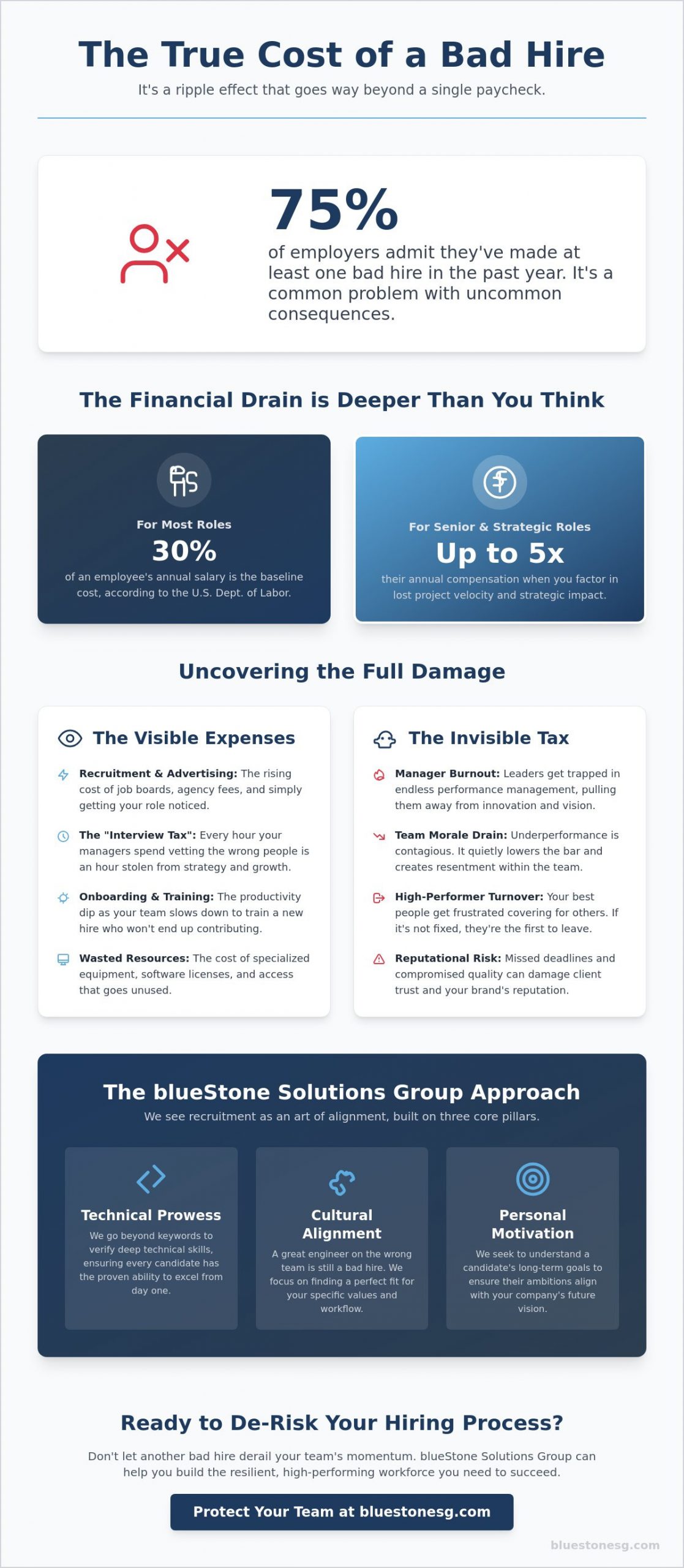
Did you know that 75% of employers admit to making at least one bad hire in the past year? It’s a sobering statistic that reflects the immense pressure of building a high performing team in a complex market. When a new addition doesn’t align with your goals, you aren’t just losing a few weeks of training. The total cost of a bad hire can reach 30% of an employee’s annual salary, and for senior strategic roles, the impact can be as high as five times their compensation. At blueStone Solutions Group, we see recruitment as an art of alignment, where the right person acts as a catalyst for your entire organization’s growth.
You likely already feel the strain when a project in your IT or engineering department begins to stall or when your best people start feeling burnt out from covering for a poor performer. We promise to help you uncover the comprehensive financial and cultural impact of these mistakes so you can better protect your bottom line. This guide provides a clear framework to calculate hiring ROI and offers proven strategies to prevent future mismatches. We will walk through the hidden organizational technical debt created by hiring errors and show you how a more meticulous vetting process can secure your vision for 2026.
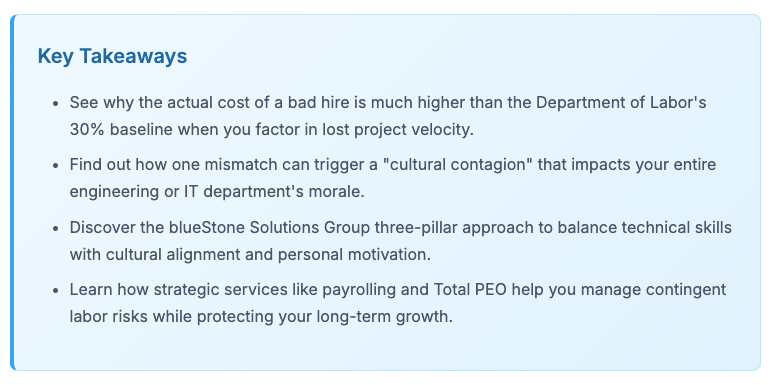
Table of Contents
- Beyond the Paycheck: Calculating the Multi-Dimensional Cost of a Bad Hire
- The Invisible Tax: How One Wrong Seat Impacts Your Entire Technical Ecosystem
- The Anatomy of a Mismatch: Why Even Great Companies Make Expensive Hiring Mistakes
- Building a Resilient Workforce: Strategic Ways to De-Risk Your Recruitment Process
Beyond the Paycheck: Calculating the Multi-Dimensional Cost of a Bad Hire
A bad hire isn’t just someone who lacks technical proficiency. Often, it’s a subtle mismatch between individual talent and the organizational environment. When these two forces don’t align, the resulting friction creates a quiet but persistent drain on your resources. The U.S. Department of Labor suggests that the costs of employee turnover start at a minimum of 30% of an annual salary. However, for specialized roles in IT or engineering, this figure is often much higher.
At blueStone Solutions Group, we view every placement as a long-term investment rather than a transactional expense. When you calculate the cost of a bad hire, you have to look past the obvious salary losses. It’s about separating the visible invoices from the invisible drain on your team’s momentum. A poor fit acts as a form of organizational technical debt that compounds every day they remain in the seat, affecting everything from team morale to client trust.
The Visible Expenses: Recruitment and Onboarding
Bringing a new person into your ecosystem requires a significant resource commitment. You’re paying for specialized equipment and software licenses that may go to waste if the hire doesn’t stay. There is also a substantial productivity gap as the team slows down to assist the newcomer. The Ramp-up Period is the time until a hire generates more value than they consume. When a hire fails before reaching this break-even point, your company absorbs the entire cost of their learning curve without any of the expected rewards.
The Training Sinkhole
The best accounting talent usually isn’t looking at public job boards. These high-impact professionals are often “passive” candidates who are already well-employed and respected in their current roles. Accessing this hidden talent pool requires deep roots in established industry networks that generalist firms simply don’t have. We leverage these connections to find professionals who aren’t just looking for any job, but for the right alignment with a new organizational environment. Accounting staffing is the strategic alignment of technical expertise and organizational culture to ensure long-term stability.
The Invisible Tax: How One Wrong Seat Impacts Your Entire Technical Ecosystem
A single hiring mistake doesn’t just sit in a vacuum. It ripples through your entire technical infrastructure. We call this “Cultural Contagion.” When one person consistently underperforms or fails to align with your values, it quietly lowers the performance bar for everyone else. In specialized sectors like IT and engineering, the cost of a bad hire often manifests as organizational technical debt. This isn’t just about sloppy code; it’s about the long-term rework and architectural flaws that your remaining team must eventually untangle. According to U.S. Department of Labor data, the financial hit is substantial, but the emotional drain on your leadership is often far worse.
Managers frequently find themselves trapped in a cycle of performance management that yields little return. Instead of architecting the future, they’re stuck in the weeds, correcting basic errors and mediating team friction. This leads to profound manager burnout. At blueStone Solutions Group, we prioritize the organizational environment as much as technical skills. We know that protecting your team’s culture is the only way to maintain your project velocity and long-term vision.
The Morale Drain and High-Performer Turnover
Your “A-players” are your most valuable asset, but they’re also the most sensitive to a poor fit. When top talent has to constantly cover for a bad hire, frustration builds quickly. They didn’t sign up to fix preventable bugs or redo calculations. If the situation persists, these high performers are usually the first to walk out the door. When they leave, they take years of institutional knowledge with them. Rebuilding that trust and replacing that expertise is a monumental task that most budgets aren’t prepared to handle.
Reputational Risk and Client Impact
The damage often extends beyond your office walls. In client-facing or high-stakes engineering roles, a bad hire can lead to missed deadlines and compromised quality. This creates a reputational risk that is hard to quantify but impossible to ignore. Think about the projects you missed because your team was busy firefighting mistakes. These lost opportunities are a direct result of hiring friction. To ensure your next project stays on track, consider how our IT project solutions can help align the right talent with your specific goals.
The Anatomy of a Mismatch: Why Even Great Companies Make Expensive Hiring Mistakes
Even the most successful organizations fall into the trap of the “Desperation Hire.” When a critical seat stays empty too long, the pressure to fill it often overrides the need for a perfect match. This haste leads to a six-figure mistake that quickly ripples through your budget. According to Gallup research on turnover costs, replacing a single employee can cost up to twice their annual salary. This makes a “quick fix” a primary driver for the rising cost of a bad hire in the modern workplace.
At blueStone Solutions Group, we see a successful match as a balance of three pillars: Skill, Will, and Environment. A traditional resume might show technical proficiency, but it rarely reveals if a candidate has the drive to innovate or the temperament to thrive in your specific culture. We’ve moved past the “culture fit” trap, which often hides implicit bias, and instead focus on “culture add.” This shift ensures the cost of a bad hire doesn’t become a recurring drain on your resources. It allows you to build a team that is diverse in thought yet unified in purpose.
Vetting Gaps in Technical Roles
There’s a massive difference between “knowing the tool” and “solving the problem.” Standard HR vetting often lacks the technical depth to distinguish between someone who follows instructions and someone who can architect solutions. Technical vetting must be as rigorous as the projects the hire will lead. Without this depth, you risk bringing in talent that looks great on paper but fails to deliver in high-stakes IT or engineering environments. It’s about finding the visionary who understands the “why” behind the code, not just the “how.”
Misalignment with Organizational Environment
Soft skills are no longer optional in the highly collaborative and remote-heavy landscape of 2026. A candidate might be a technical genius in isolation but a disaster for team momentum. The blueStone Solutions Group approach focuses on matching talent with your company’s unique DNA. We ensure interpersonal connections are as strong as technical ones. This meticulous process prevents the friction that usually leads to early turnover. If you’re ready to stop the cycle of expensive mismatches, explore our Engineering Staffing to find your next great “culture add.”
Building a Resilient Workforce: Strategic Ways to De-Risk Your Recruitment Process
Building a resilient workforce isn’t about filling seats faster. It’s about fundamentally changing how you view the talent acquisition lifecycle. To truly eliminate the cost of a bad hire, you need to move from reactive staff augmentation to a strategic partnership model. This is where blueStone Solutions Group excels. We act as a visionary architect for your talent strategy, ensuring every individual we present is capable of driving your business forward. By aligning your long term goals with our specialized recruitment expertise, you create a hiring process that is both meticulous and scalable.
Our team doesn’t just scan resumes. Our specialized recruiters speak the language of IT, Finance, and Engineering. They understand the difference between a candidate who can simply use a tool and one who can solve a complex architectural problem. This deep industry knowledge allows us to filter out mismatches long before they reach your desk. It turns recruitment from a high stakes gamble into a predictable part of your growth strategy.
The Benefits of Professional Vetting and Staffing
Partnering with a specialized firm does more than just find candidates. It protects your most valuable internal resource: your management team’s time. By reducing the “Interview Tax,” your leaders can stay focused on high level project execution. We also maintain a deep talent bench, which means we are proactive rather than reactive when you need to scale. There are several clear advantages to this partnership:
- Reduced Administrative Burden: We handle the heavy lifting of initial vetting and credentialing.
- Access to Hidden Talent: We tap into networks of passive candidates who aren’t on the public job boards.
- Diversity as a Driver: As a WBE-certified firm, blueStone Solutions Group helps you build diverse teams that bring fresh, innovative perspectives to your technical challenges.
Implementing a “Try-Before-You-Buy” Model
Risk mitigation is essential when the cost of a bad hire is so high. Using a “Try-Before-You-Buy” model through our contract-to-hire or staff augmentation services allows you to assess a candidate’s impact in your specific environment before making a permanent commitment. This real world trial period is the ultimate vetting tool. Our payrolling services and Total PEO solutions handle the administrative weight of these contingent workers, from onboarding to compliance. This streamlined approach ensures that your specialized contractors are ready to contribute on day one without distracting your HR team. Partner with blueStone Solutions Group to ensure your next hire is a high-impact success.
Securing Your Future Through Strategic Alignment
A hiring mismatch is more than just a line item on a budget. It’s an invisible tax on your team’s momentum and a direct risk to your client relationships. By moving beyond traditional resumes and focusing on the three pillars of skill, will, and environment, you protect your “A-players” from the burnout that follows a poor fit. Understanding the true cost of a bad hire is the first step toward building a resilient organization that actually gains speed over time.
At blueStone Solutions Group, we combine our specialized expertise in IT, Engineering, and Finance with a deep commitment to finding the ideal alignment between individual talent and company DNA. As a Certified Women’s Business Enterprise (WBE), we bring a meticulous and visionary perspective to every search. We don’t just fill seats; we architect teams capable of handling your most complex project executions. Let blueStone Solutions Group help you find your next high-impact hire today. Your vision for 2026 deserves a team that can turn your most ambitious goals into a reality.
Frequently Asked Questions
What is the average cost of a bad hire in 2026?
The cost of a bad hire in 2026 typically starts at 30% of the employee’s first-year salary according to U.S. Department of Labor data. For senior executives or specialized engineering roles, that figure can climb to five times their annual compensation. These costs aren’t just about the lost salary; they include the price of re-recruiting and the drain on your internal management’s focus during the replacement process.
How do you calculate the true cost of employee turnover?
To calculate the true cost of turnover, you need to sum up direct recruitment fees, administrative overhead, and the productivity gap during the ramp-up period. You should also factor in the “interview tax,” which is the hourly cost of your leadership team’s time spent interviewing instead of focusing on strategy. blueStone Solutions Group helps clients track these metrics to demonstrate the ROI of a more meticulous vetting process.
Can a bad hire damage company culture permanently?
While few things are truly permanent, a bad hire can cause lasting damage by lowering the performance bar for your entire department. This often leads to “A-player” turnover, where your best people leave because they’re frustrated by a lack of alignment. Rebuilding team trust and replacing lost institutional knowledge can take months. We focus on “culture add” to ensure every new hire strengthens your organizational environment.
How much time should a manager spend on a new hire during onboarding?
Most managers should anticipate dedicating at least 20 to 30 hours to direct onboarding and mentorship during the first three months. This investment ensures the new hire moves through the ramp-up period as quickly as possible. When a hire fails, this significant temporal investment is completely lost. Our staffing solutions aim to reduce this burden by ensuring candidates are technically and culturally prepared for your specific challenges from day one.
What are the most common signs of a bad hire in technical roles?
Look for a lack of solution-oriented thinking and a failure to integrate with your existing technical ecosystem. In engineering or IT, a bad hire often creates technical debt by writing code that requires extensive rework from others. You’ll also see a mismatch in communication styles that slows down collaborative sprints. These early red flags indicate that the hire doesn’t align with your long-term project goals or team DNA.
Is it better to use a staffing agency or hire directly to avoid bad hires?
Utilizing a specialized agency is often the best way to de-risk the recruitment process for technical or financial roles. blueStone Solutions Group provides access to a pre-vetted talent bench that most internal HR departments don’t maintain. By using contract-to-hire or staff augmentation models, you get a real-world trial period to ensure the fit is perfect. This strategic approach significantly reduces the financial and cultural risks associated with direct permanent hiring.