What if the biggest threat to your project ROI isn’t the technical complexity of the task, but the two weeks it takes your new engineer to actually start coding? You likely feel the pressure to scale quickly, but you also know that slow start-up times for technical contractors can drain your budget and stall momentum. At blueStone Solutions Group, we believe that implementing onboarding best practices for contract employees is the key to turning that friction into a competitive advantage. With 83 million Americans now working as freelancers in 2026, your ability to integrate this talent determines how fast your organization can innovate.
This guide will show you how to master the art of integrating contingent talent quickly and compliantly to drive immediate project ROI. We’ll explore repeatable workflows that ensure immediate contributions from IT and engineering talent while navigating the legal minefield of new 2026 regulations, such as the NJ ABC Test and the proposed federal five-factor test. By bridging the gap between your internal teams and staff augmentation partners, you can create a professional environment where every individual feels empowered to succeed. Let’s look at how to build a seamless integration process that protects your business and inspires your people.
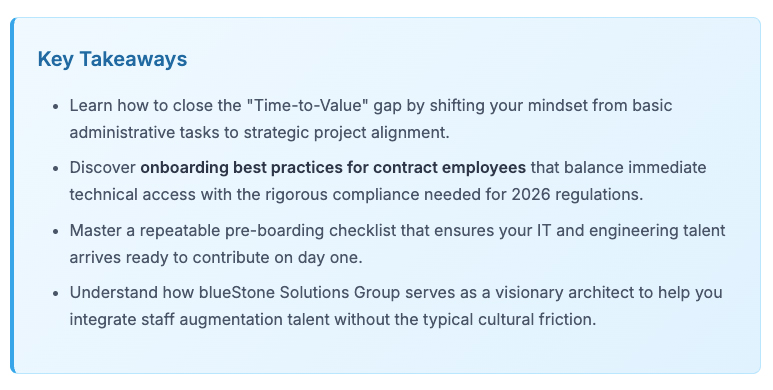
Table of Contents
- Why Traditional Onboarding Fails Contract Employees in 2026
- The 4 Pillars of a High-Impact Contractor Onboarding Framework
- A Manager’s Checklist for Onboarding Contract Employees
- Scaling with Confidence: How blueStone Solutions Group Simplifies Onboarding
Why Traditional Onboarding Fails Contract Employees in 2026
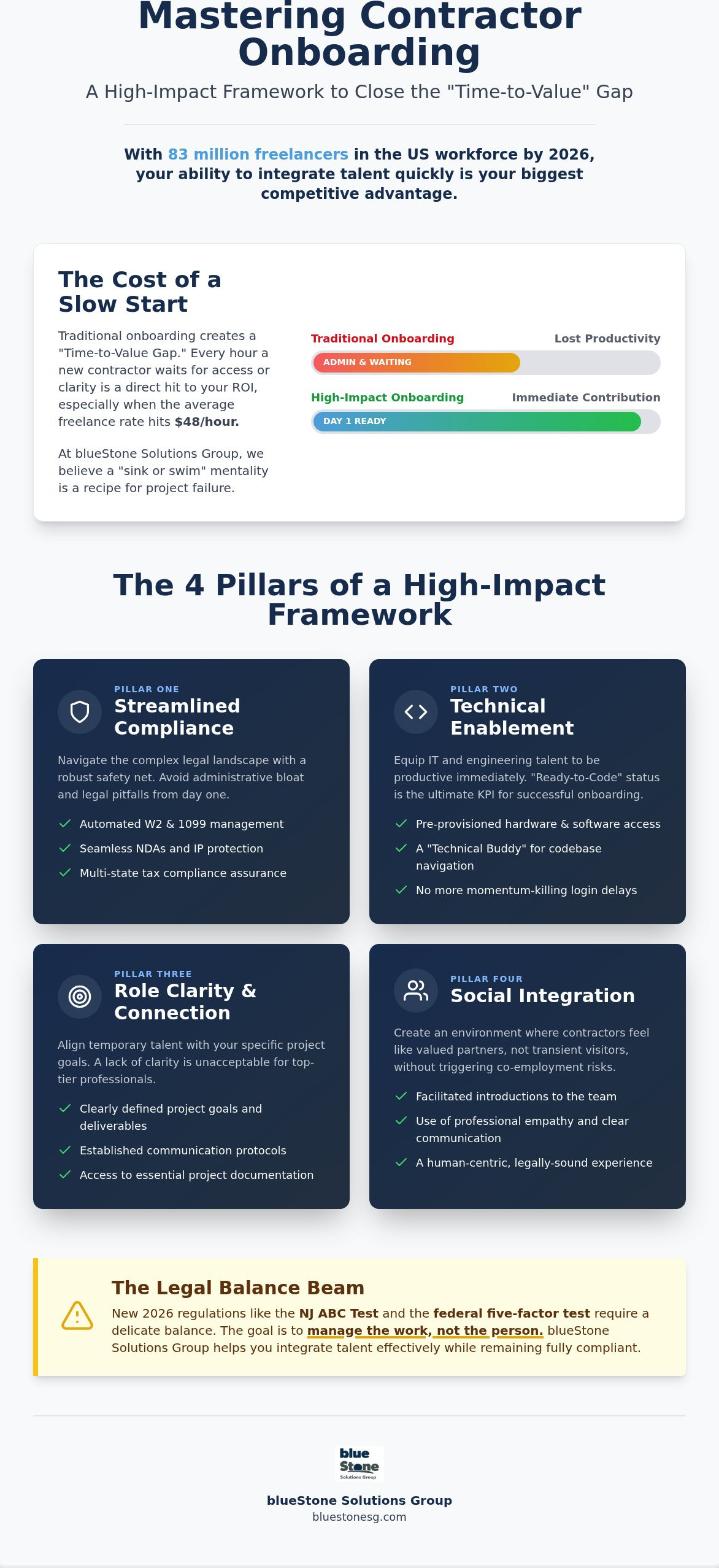
Many leaders view contractor onboarding as a simple checklist of passwords and tax forms. This is a missed opportunity. Strategic onboarding or organizational socialization isn’t just about administrative compliance; it’s the intentional alignment of temporary talent with your specific project goals. When you treat a contractor like a transient visitor, you’re essentially planning for friction. In 2026, where the average hourly rate for North American freelancers has hit $48, every hour spent waiting for system access or clarifying a deliverable is a direct hit to your bottom line.
The “Time-to-Value” gap is the primary reason enterprise projects stall. If an engineer takes three days to understand the codebase because of poor documentation, you’ve lost thousands in potential ROI. At blueStone Solutions Group, we believe that the organizational environment is a standalone service pillar. We don’t just provide talent; we help you build the infrastructure that allows that talent to thrive from the very first hour. High-impact onboarding best practices for contract employees require moving beyond the transactional to create a partnership that drives results.
The Cost of ‘Sink or Swim’ Mentality
Leaving a contractor to “figure it out” is a recipe for disaster. In a competitive 2026 market where 5.6 million independents earn over $100,000, top-tier talent won’t tolerate a lack of clarity. They’ll simply move to the next project. Poor onboarding leads to immediate dropoff, forcing you back into the expensive cycle of sourcing and interviewing. The Contractor Experience Gap is the delta between technical skill and project context. Without that context, even a genius coder is just a guest in your system, unable to make the high-stakes decisions you hired them for.
Co-Employment vs. Cultural Integration
Navigating the legal landscape is more complex than ever. With the New Jersey ABC Test regulations taking effect in October 2026 and federal rules shifting back to a five-factor test, you have to be careful. You must manage the work without appearing to manage the person as a traditional employee. However, this doesn’t mean you should ignore culture. You can make contractors feel like valued partners through clear communication and professional empathy without triggering co-employment risks. blueStone Solutions Group specializes in this delicate balance, ensuring your onboarding best practices for contract employees remain both human-centric and legally sound.
The 4 Pillars of a High-Impact Contractor Onboarding Framework
Building a framework for contingent talent requires more than a standard welcome email. You need a structured blueprint that balances speed with precision. To truly master onboarding best practices for contract employees, your strategy must rest on four essential pillars: Compliance, Technical Access, Role Clarity, and Social Integration. When these pillars are strong, you transform a temporary worker into a high-impact contributor. This isn’t just about getting them through the door; it’s about architectural excellence in your talent strategy.
Streamlining Compliance and Payrolling
Compliance is your safety net. In 2026, the regulatory landscape is shifting rapidly, and administrative bloat can easily derail your project timelines. You must automate W2 and 1099 management to ensure accuracy and speed. Essential documentation, including NDAs, IP protection, and multi-state tax compliance, must be handled with meticulous care to avoid legal pitfalls. At blueStone Solutions Group, our Total PEO and payrolling services are designed to remove this HR burden from your internal team. We handle the heavy lifting of complex execution, allowing you to focus on your core business objectives while we ensure every contractor is fully compliant from day one.
Technical Enablement for IT and Engineering
Technical access is the ultimate enabler for high-stakes roles. For an engineer or IT professional, waiting for a VPN login or software license is the ultimate momentum killer. You should pre-provision all necessary hardware and software access before their first day to ensure a seamless start. Providing a Technical Buddy can also help new talent navigate proprietary codebases or specific engineering standards without feeling like an outsider. This human-centric approach bridges the gap between technical proficiency and project context. “Ready-to-Code” status is the ultimate KPI for IT onboarding, signaling that your new talent is equipped to drive immediate value.
Clarity and Connection
The final two pillars, Role Clarity and Social Capital, provide the North Star and the glue for your contingent workforce. You must define clear KPIs and project milestones so your contractors know exactly what success looks like. While they may be temporary, fostering a sense of connection through social integration drives retention and performance. Treating your organizational environment as a service pillar ensures that contractors feel like partners rather than commodities. By implementing these onboarding best practices for contract employees, you create a professional intimacy that inspires confidence and long-term growth for everyone involved.
A Manager’s Checklist for Onboarding Contract Employees
Managers often find themselves caught between aggressive project deadlines and the administrative fog of bringing on new talent. To cut through this, you need a chronological roadmap that treats the contractor’s first week as a high-stakes launch phase. Implementing onboarding best practices for contract employees means moving beyond the “sink or swim” approach and adopting a meticulous, architected workflow. This process begins long before the first login and continues until the contractor is fully integrated into your project’s rhythm. At blueStone Solutions Group, we see this as an opportunity to build grounded reliability from the start.
The First 24 Hours: From Login to Logic
Speed is your primary metric on day one. Your goal should be “Zero-Day” access, ensuring that IT contractors have their Git and Jira credentials by 9:00 AM. This isn’t just about efficiency; it’s about signaling that you value their time and expertise. Introduce them to key stakeholders early on. They need to know who the decision-makers are, not just their immediate peers. Don’t forget the “unwritten” rules of your office environment. Whether it’s the specific way you use Slack channels or the protocol for virtual stand-ups, clear communication norms prevent early friction.
30-60-90 Day Milestones for Long-Term Contracts
For staff augmentation roles lasting six months or more, the onboarding arc must evolve. You aren’t just looking for a quick fix; you’re building a sustainable partnership. Use the 30-60-90 day framework to align their growth with your project milestones. Focus on the following areas:
- 30 Days: Evaluation of technical integration and initial task completion.
- 60 Days: Deep dive into project architecture and independent problem-solving.
- 90 Days: Full ownership of specific outcomes and contribution to the organizational environment.
Soliciting feedback is vital. Ask your contractors how the process could be smoother. This helps you refine your organizational environment and ensures you remain a destination for top-tier talent. Focus on performance-solving outcomes rather than just tracking hours logged. This results-oriented approach inspires confidence and drives immediate project ROI. When you follow these onboarding best practices for contract employees, you create a culture of professional intimacy that attracts the best in the business. If you’re ready to bypass the administrative headache and secure high-impact talent, see how our IT staffing and project solutions can transform your delivery speed.
Scaling with Confidence: How blueStone Solutions Group Simplifies Onboarding
Scaling your technical team shouldn’t feel like a chaotic experiment. You need a partner who acts as a visionary architect, designing talent solutions that align perfectly with your specific project goals. At blueStone Solutions Group, we provide much more than just a list of candidates. We deliver pre-vetted, “onboarding-ready” professionals who are prepared to hit the ground running. As a certified Women’s Business Enterprise (WBE), we don’t just help you meet your diversity spend goals; we bring a meticulous, leadership-driven perspective to your contingent workforce strategy that prioritizes quality and reliability.
Total PEO and Payrolling: Your Compliance Shield
Managing the administrative messiness of a global, remote-first workforce can quickly drain your internal resources. Our Total PEO and payrolling services act as your compliance shield, handling the heavy lifting of complex execution. We manage multi-state tax regulations and classification tests with precision, so your managers can focus entirely on technical delivery. With over 25 years of experience in IT, accounting, and engineering staffing, we understand the unique friction points of these fields. We ensure that onboarding best practices for contract employees are baked into every step of our process, protecting your business from the legal risks of misclassification.
Partnering for High-Impact Outcomes
Think of blueStone Solutions Group as a thoughtful matchmaker for excellence rather than just another traditional staffing agency. We believe that a meticulously planned organizational environment is the foundation for project success. By transitioning from transactional hiring to a deep, supportive partnership, you gain a team that is personally invested in your long-term growth. We take the burden of pre-boarding off your shoulders, ensuring every contractor arrives with the context they need to succeed from their very first hour.
Our goal is to create a seamless integration that drives immediate ROI and fosters professional intimacy between your internal teams and contingent talent. We handle the logistics, the compliance, and the sourcing, so you can lead with confidence. Let’s build your high-impact team together with blueStone Solutions Group.
Master Your Strategic Talent Acceleration
The landscape of contingent work in 2026 demands more than just paperwork; it requires a visionary approach to integration. By focusing on the “Time-to-Value” gap and establishing clear technical and social pillars, you transform temporary roles into high-impact partnerships. You’ve learned that “Ready-to-Code” status is the ultimate metric for success and that a meticulous 30-60-90 day roadmap ensures long-term project alignment. Implementing onboarding best practices for contract employees isn’t just about efficiency. It’s about creating an organizational environment where the best technical talent feels empowered to innovate immediately.
At blueStone Solutions Group, we’ve spent over 25 years refining this architectural approach to staffing. Founded in 2000, we’ve built specialized IT and engineering talent pipelines that prioritize both technical proficiency and cultural fit. As a certified Women’s Business Enterprise (WBE), we handle the complex logistics and compliance of your workforce so you can focus on the artistic nature of your project delivery. We’re ready to serve as your strategic partner in building a resilient, high-performing team. Scale your technical team with blueStone Solutions Group and turn your next project into a masterpiece of execution. We can’t wait to see what you’ll build next.
Frequently Asked Questions
What is the difference between onboarding a contractor and a full-time employee?
Contractor onboarding is built for speed and project-specific alignment, whereas full-time onboarding focuses on long-term career growth. For a contractor, you’re prioritizing technical context and immediate deliverables. Full-time employees spend weeks on general orientation, but contract talent needs to be productive within hours. blueStone Solutions Group specializes in this high-speed transition to ensure you don’t lose momentum.
How can I avoid co-employment risk during the onboarding process?
You avoid co-employment risk by focusing on work results rather than behavioral management. Don’t provide contractors with the same handbooks or performance reviews you give to regular staff. Implementing onboarding best practices for contract employees means keeping a clear line between project milestones and employee-only perks. blueStone Solutions Group acts as a compliance shield by handling the complex administrative side of these relationships for you.
What technical access should a contract engineer have on their first day?
A contract engineer should have full access to the development environment, version control systems, and project management tools like Jira. They also need a seat in your communication channels from the start. “Zero-Day” access is the target. If they aren’t ready to code by lunch, your project ROI is already taking a hit. We ensure our candidates are technically prepared for this immediate integration.
How long should the onboarding process for a contract worker last?
The most intense phase lasts 24 to 48 hours, but the full cycle should include a 30-day “check-back” rhythm. While the administrative part is fast, the technical alignment requires a few weeks of consistent feedback. This ensures the contractor stays aligned with the project’s evolving architecture. A well-structured arc prevents the “sink or swim” dropoff that often happens in high-stakes engineering roles.
Can a PEO help with onboarding contractors in different states?
A Total PEO service is essential for managing the legal messiness of a multi-state workforce. With new 2026 state-level regulations like the New Jersey ABC test, you need a partner who understands the nuances of classification. blueStone Solutions Group uses a PEO model to handle these logistics. This allows your managers to focus on technical delivery while we manage the compliance headaches across different jurisdictions.
Why is cultural integration important for a short-term IT contractor?
Cultural integration isn’t about long-term loyalty; it’s about reducing friction. When a contractor understands your communication norms and decision-making styles, they make fewer mistakes and integrate faster. onboarding best practices for contract employees include a visionary welcome that makes them feel like partners. This human-centric approach drives immediate results and ensures that technical proficiency isn’t wasted on cultural misunderstandings.