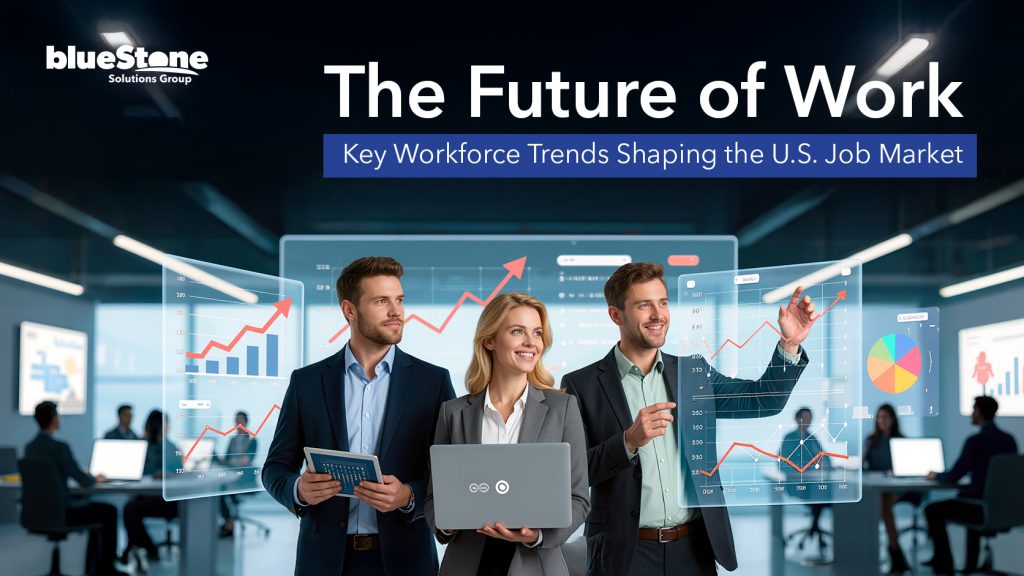
“We’re still hiring—but not in the same way we used to.” That’s something we’re hearing more often from business leaders today.
At blueStone Solutions Group, it reflects a broader shift across the U.S. job market in 2026. Work isn’t disappearing—but it is evolving. The way organizations attract, evaluate, and deploy talent is being reshaped by new realities.
Continuous Learning: The Workforce Skill Gap Is Growing
One of the biggest challenges shaping the future of work is the accelerating gap between evolving business needs and workforce capabilities. As technology continues to advance, many organizations are realizing that traditional hiring alone is no longer enough to keep pace with change.
At blueStone Solutions Group, we’re seeing a stronger emphasis on continuous learning and workforce upskilling across industries. Employers are increasingly prioritizing professionals who can adapt quickly, learn new technologies, and evolve alongside changing business demands. In many ways, adaptability itself is becoming one of the most valuable skills in the modern workforce.
The companies that will lead in the years ahead are not just those hiring top talent—they are the ones actively investing in building future-ready teams capable of navigating constant transformation.
The Gig Economy: From Flexibility to Strategy
The gig economy is no longer a side conversation—it’s becoming a core part of workforce strategy. In the United States, nearly 72.9 million professionals are engaged in freelance work, contributing close to $1.5 trillion to the economy.
What was once seen as temporary or supplemental is now a reliable source of specialized talent. Organizations are increasingly turning to flexible professionals to accelerate delivery, access niche skills, and stay responsive in a fast-changing market. The workforce is no longer fixed—it’s becoming fluid, on-demand, and outcome-driven.
Automation: Redefining Work, Not Replacing It
Automation and AI continue to reshape the nature of work. However, while the conversation often focuses on job displacement, the reality is more balanced. In fact, studies indicate that up to 80% of the workforce may see portions of their roles transformed by AI.
Therefore, this shift is less about elimination and more about evolution. As a result, as routine tasks become automated, the value of human skills—such as critical thinking, creativity, and adaptability—continues to rise. Consequently, organizations that succeed will be those that not only adopt technology, but also align it with human capability.
Skills-Based Hiring: A New Lens on Talent
One of the most impactful changes in hiring is the move toward skills-based evaluation. Employers are placing greater emphasis on what candidates can do, rather than solely on where they’ve worked or studied.
This shift is expanding access to talent and enabling companies to hire more effectively in a rapidly changing environment. It also reflects a simple truth: skills evolve faster than job descriptions. At blueStone, we’re seeing organizations prioritize agility and capability over traditional credentials—unlocking stronger, more future-ready teams.
blueStone POV: What This Means for Businesses
These trends are not isolated—they are interconnected. The rise of flexible work models, the integration of automation, and the shift toward skills-based hiring are collectively redefining workforce strategy.
Organizations that adapt early are not just responding to change—they are positioning themselves to lead. The focus is shifting from building static teams to creating dynamic, scalable, and skills-driven workforces.
Final Thought
The future of work isn’t about fewer opportunities—it’s about different ones. Companies that embrace flexibility, invest in skills, and integrate technology effectively will be better equipped to navigate uncertainty and drive growth.
At blueStone Solutions Group, we help organizations stay ahead of this shift—because the future of work isn’t something to wait for. It’s something to build for. If you’re rethinking your workforce strategy for 2026, let’s start the conversation.