What if the very agility your organization relies on is actually creating a silent financial liability? With the Department of Labor’s February 2026 proposal to re-establish a strict “economic realities” test, the risks of hiring independent contractors have reached a critical turning point for every forward-thinking organization. You likely value the specialized talent and speed that 1099 workers bring to your high-impact engineering or IT projects. It’s a smart way to stay lean while pursuing ambitious goals, but the legal landscape is shifting beneath your feet.
The line between a partner and an employee has blurred, leaving many leaders vulnerable to massive back-tax audits and lost intellectual property rights. At blueStone Solutions Group, we believe you shouldn’t have to choose between operational friction and legal safety. This guide will clarify the latest 2026 classification tests and provide a clear strategy to maintain a flexible workforce securely. You’ll learn how to lower your administrative burden while protecting the human-centric values and technical excellence that drive your long-term success.
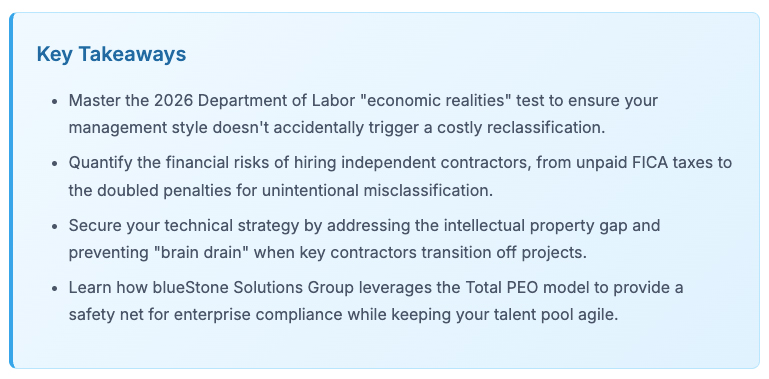
Table of Contents
- The Control Paradox: Why the Primary Benefit of Contractors is Also Your Biggest Risk
- The Triple Threat: Financial, Legal, and Tax Risks of Misclassification
- Operational and IP Risks: The Hidden Dangers to Your Technical Strategy
- How to Mitigate Risk Without Slowing Down: Strategic Solutions
The Control Paradox: Why the Primary Benefit of Contractors is Also Your Biggest Risk
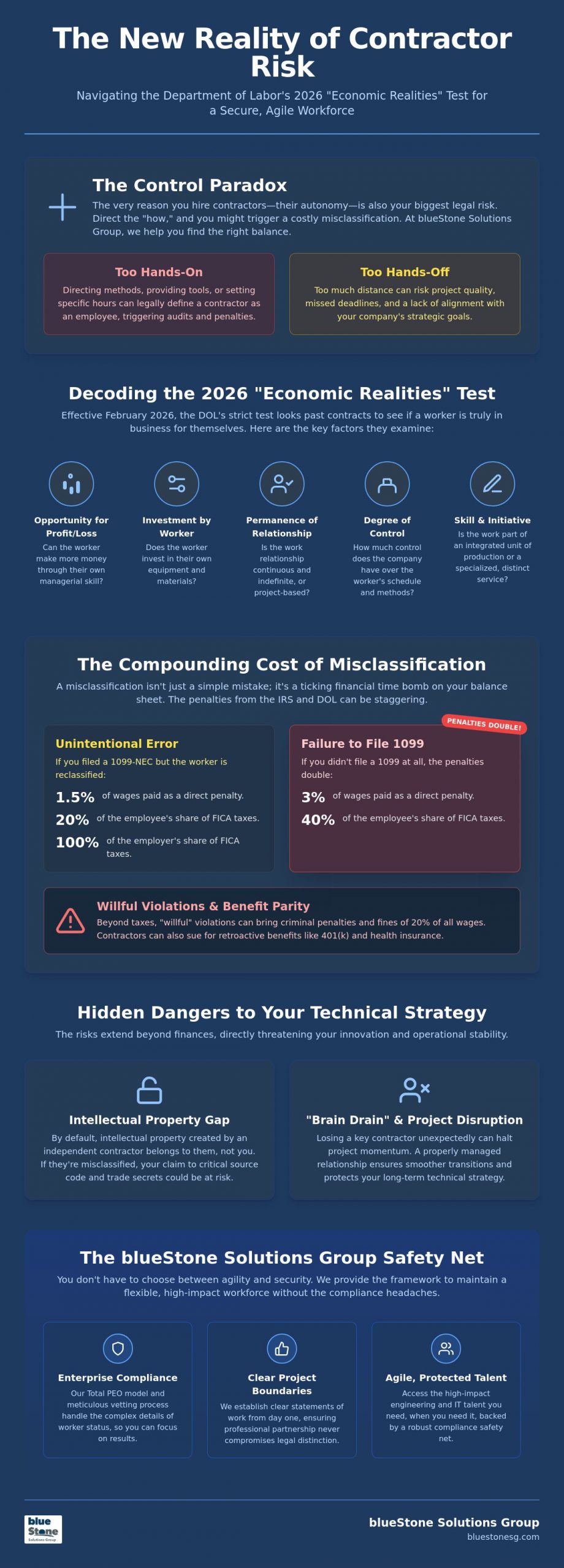
Autonomy is likely the reason you hire specialized talent. You need a senior developer to execute a high-impact project without the long-term administrative weight of a permanent hire. However, this independence creates a management paradox. Federal regulators look closely at how much you direct the work being performed. If you direct the “how” rather than just the final result, that worker is legally an employee. This tension sits at the heart of the risks of hiring independent contractors right now. If you’re too hands-on, you trigger a misclassification audit. If you’re too hands-off, you might miss your project deadline.
At blueStone Solutions Group, we see this challenge frequently in high-stakes IT and engineering fields. Leaders want to ensure excellence, but the law often demands a distance that feels counterintuitive to project success. We bridge this gap through strategic staffing models that align your operational needs with current compliance standards.
The Legal Definition of “Independence” in 2026
The regulatory environment shifted on February 26, 2026, when the Department of Labor proposed a return to a strict five-factor “economic realities” test. This framework focuses heavily on the nature and degree of control an organization has over the work. While the U.S. definition of an independent contractor historically emphasized worker autonomy, the 2026 standard asks if the worker is truly in business for themselves. Freedom of action is a double-edged sword for project managers. It allows for flexibility, but it also means you cannot legally dictate the specific methods a contractor uses to reach the finish line. Misclassification is the legal determination that a 1099 worker is actually an employee, a mistake that creates a massive, unrecorded financial liability for back taxes and unpaid benefits.
Why Your Contract Might Not Be Enough
A signed 1099 agreement isn’t a bulletproof shield. Auditors from the IRS and DOL look past the paperwork to examine the day-to-day working relationship. They check for behavioral control indicators like mandatory training sessions, company-provided hardware, or requirements to work specific hours. If your “contractor” follows your employee handbook and attends every internal stand-up, a contract won’t protect you from the risks of hiring independent contractors. blueStone Solutions Group mitigates this by meticulously vetting technical talent and establishing clear project boundaries from day one. We ensure that professional partnership never compromises the legal distinction required for a safe, flexible workforce.
The Triple Threat: Financial, Legal, and Tax Risks of Misclassification
Think of misclassification as a ticking clock on your balance sheet. While the initial savings on benefits might look attractive, the risks of hiring independent contractors often include a compounding financial liability that only surfaces during a surprise audit. If the IRS determines a worker is actually an employee, you’re immediately responsible for 100% of the employer’s share of FICA taxes. For unintentional errors where you filed a 1099-NEC, you’ll also face a penalty of 1.5% of wages and 20% of the employee’s share of FICA. If you failed to file that 1099, those penalties double to 3% and 40% respectively. These numbers don’t just represent a fee; they represent a direct hit to your project’s ROI.
The stakes climb even higher if the Department of Labor finds a “willful” violation. In these cases, you could face criminal penalties and fines of 20% of all wages paid to the worker. Beyond the tax office, there’s the “benefit parity” risk. Excluded contractors who feel they’ve been treated like employees can sue for retroactive access to 401(k) plans and health insurance. It’s a complex execution of compliance that many firms aren’t equipped to handle while simultaneously trying to innovate. This is where the professional intimacy of a partnership with blueStone Solutions Group helps, as we handle the meticulous details of worker status so you can focus on growth.
The IRS and State-Level “ABC” Tests
Compliance is rarely a single-track process. While you’re balancing the IRS criteria for worker classification, you’re also navigating a fragmented map of state laws. California’s strict ABC test and New Jersey’s October 2026 updates create a minefield for organizations with remote technical teams. Managing a multi-state workforce requires a level of meticulousness that can slow down your most ambitious goals. Many visionary leaders choose to mitigate the risks of hiring independent contractors by utilizing payrolling services from blueStone Solutions Group, ensuring every hire is correctly classified across every jurisdiction.
Workers Compensation and Disability Gaps
Don’t assume a virtual workspace protects you from physical liabilities. If an uninsured contractor is injured while performing work for you, the lack of workers’ compensation coverage can lead to direct lawsuits against your organization. The “Safe Harbor” exception is becoming harder to qualify for in 2026 as auditors tighten their definitions of industry standards. For mid-market firms, the average cost of a misclassification audit often exceeds the original project budget by three to four times once back wages and liquidated damages are tallied.
Operational and IP Risks: The Hidden Dangers to Your Technical Strategy
Your code is your crown jewel. While the financial penalties discussed earlier are daunting, the operational risks of hiring independent contractors can be even more destructive to your long-term roadmap. Technical projects thrive on continuity and deep institutional knowledge. When a key contractor leaves mid-sprint, they don’t just leave a vacancy; they create a “brain drain” that can stall your momentum for months. This instability is a silent architect of project failure, especially in high-stakes engineering environments where every line of code is an investment in your future.
At blueStone Solutions Group, we act as a Visionary Architect for your workforce. We understand that technical proficiency is only half the battle. Building a stable, compliant team requires a meticulous approach to how talent integrates with your existing systems and culture. Without this strategic alignment, you risk creating a fragmented organizational environment where 1099 workers feel like temporary outsiders rather than invested partners.
Who Owns Your Code? The 1099 IP Reality
Ownership is not automatic. Under the Fair Labor Standards Act and standard copyright principles, work created by an employee is generally “work for hire,” meaning the company owns it. For contractors, the default often flips. Unless your agreement contains specific, ironclad assignment language, the contractor may legally retain the rights to the software or designs they created. This creates a massive IP trap during acquisitions or funding rounds. You must also guard against “shadow IT” risks, where contractors use unvetted personal tools or AI platforms that leak your proprietary data. To protect your assets, ensure your technical consulting roles include:
- Explicit “Assignment of Rights” clauses for all deliverables.
- Strict hardware and software compliance standards for remote work.
- Documented knowledge transfer protocols during every project milestone.
The Impact on Organizational Environment
A high-risk 1099 culture often leads to low engagement and high turnover. In 2026, top-tier technical talent is increasingly moving toward the stability and growth opportunities found in W2 roles. If your team is a revolving door of contractors, your permanent staff will face “burnout by proxy” as they constantly onboard new faces. blueStone Solutions Group focuses on matching talent to your specific organizational environment, ensuring that every professional we place is a long-term fit for your technical strategy. If you want to build a team that stays as long as the code they write, explore our IT staffing solutions to find the perfect match.
How to Mitigate Risk Without Slowing Down: Strategic Solutions
Protecting your organization from the risks of hiring independent contractors doesn’t mean you have to sacrifice the agility that drives your innovation. You’ve built an ambitious vision for your technical projects. We provide the grounded reliability to ensure that vision isn’t derailed by a surprise audit. By shifting from a reactive posture to a proactive strategy, you can maintain a flexible workforce while eliminating the “Control Paradox” entirely. A thoughtful assessment today prevents the complex execution of a legal defense tomorrow.
To secure your operations, follow this 5-step risk assessment framework for your current 1099 roles:
- Analyze Behavioral Control: Review if your project managers are dictating the “how” and “when” rather than just the final result.
- Map Multi-State Compliance: Check if your remote contractors reside in states like California or New Jersey where “ABC” tests are significantly stricter.
- Audit IP Language: Confirm that every contractor agreement includes explicit assignment of rights for all code and designs.
- Evaluate Brain Drain: Identify which 1099 roles hold critical institutional knowledge that would be lost if they left mid-sprint.
- Select a Compliant Model: Determine if high-risk roles should transition to a Total PEO or payrolling model.
Transitioning High-Risk Roles to W2
Identifying “low hanging fruit” for an audit is the first step toward safety. If a contractor has worked exclusively for you for over a year or uses company-provided equipment, they are a primary target for reclassification. Transitioning these roles to a W2 structure through blueStone Solutions Group payrolling services allows you to keep your preferred talent without the liability. This process minimizes project disruption by handling the administrative burden of benefits and taxes, giving your workers the stability they increasingly seek in 2026. It’s a win-row outcome that preserves your project momentum while closing the gap on financial risks.
The blueStone Solutions Group Advantage
We’re more than a staffing firm; we’re a Visionary Architect for your workforce strategy. As a Certified Women’s Business Enterprise (WBE) with over 25 years of expertise, blueStone Solutions Group helps you meet diversity spend goals while providing meticulous oversight for your IT, accounting, and engineering staffing. Our “Thoughtful Matchmaker” approach ensures that every professional is aligned with your specific organizational environment. We handle the complex execution of compliance through our Total PEO and payrolling services, allowing you to focus on high-level growth. Don’t let classification anxiety slow your progress. Contact blueStone Solutions Group to audit your contractor risks today!
Securing Your Future Workforce with Confidence
The 2026 regulatory landscape has redefined how ambitious organizations manage their talent. We’ve explored how the “Control Paradox” can turn a flexible project into a legal liability and why protecting your intellectual property is just as critical as avoiding tax penalties. Understanding the risks of hiring independent contractors is the first step toward building a resilient, high-performing team that can weather any audit. You don’t have to navigate these complexities alone or slow your momentum to stay compliant.
As a Certified Women’s Business Enterprise (WBE) with over 25 years of specialized IT, accounting, and engineering expertise, blueStone Solutions Group is your visionary partner in workforce strategy. We provide the Total PEO and payrolling safety nets you need to execute your most complex projects without the weight of misclassification anxiety. It’s time to shift from uncertainty to a grounded, secure strategy that empowers both your organization and the individuals who drive its success. Partner with blueStone Solutions Group to secure your technical workforce and move forward with the peace of mind you deserve.
Frequently Asked Questions
What is the “Right to Control” test for independent contractors?
The “Right to Control” test evaluates whether an organization directs the specific methods and sequences of a worker’s tasks. If you dictate the tools used or the exact hours worked, the worker is legally considered an employee. This test is a cornerstone of the IRS and DOL classification frameworks. It ensures that true contractors maintain the independence to deliver results using their own professional methods rather than being micromanaged.
Can I be fined if I accidentally misclassify a worker as a 1099 contractor?
You can absolutely be fined for unintentional errors, as the IRS imposes strict penalties regardless of your intent. For a misclassification where a 1099-NEC was filed, you’ll typically face a penalty of 1.5% of the worker’s wages plus 20% of the employee’s share of FICA taxes. These costs escalate quickly during an audit. blueStone Solutions Group helps you avoid these financial surprises by ensuring your technical talent is classified correctly from day one.
What are the 2026 Department of Labor rules for independent contractors?
The 2026 Department of Labor rule re-establishes a five-factor “economic realities” test that prioritizes the nature of control and the worker’s opportunity for profit or loss. This shift moves away from the 2024 standards and places a heavier burden on employers to prove a worker’s true independence. It’s a complex regulatory change that demands a meticulous review of all current 1099 relationships to mitigate the risks of hiring independent contractors.
How does a PEO help with independent contractor misclassification risks?
A Total PEO helps by serving as the legal Employer of Record for your workforce, effectively shifting the compliance and tax liability away from your organization. By transitioning high-risk 1099 roles into a PEO model, you maintain access to top-tier talent while blueStone Solutions Group handles the complex execution of payroll, benefits, and tax filings. This safety net allows you to focus on your ambitious technical goals without the constant fear of a misclassification audit.
Do I own the intellectual property created by an independent contractor?
You don’t automatically own intellectual property created by an independent contractor unless your contract includes specific “work for hire” or assignment language. Without these clauses, the default legal standard often leaves ownership with the creator. This is a common trap in IT and engineering projects.
What is the difference between a 1099 contractor and a W2 employee for payroll taxes?
The primary difference lies in who carries the tax burden, as 1099 contractors are responsible for the full 15.3% self-employment tax. For W2 employees, the employer must pay 7.65% for Social Security and Medicare while also contributing to federal and state unemployment insurance. Miscalculating these contributions is one of the biggest risks of hiring independent contractors.