

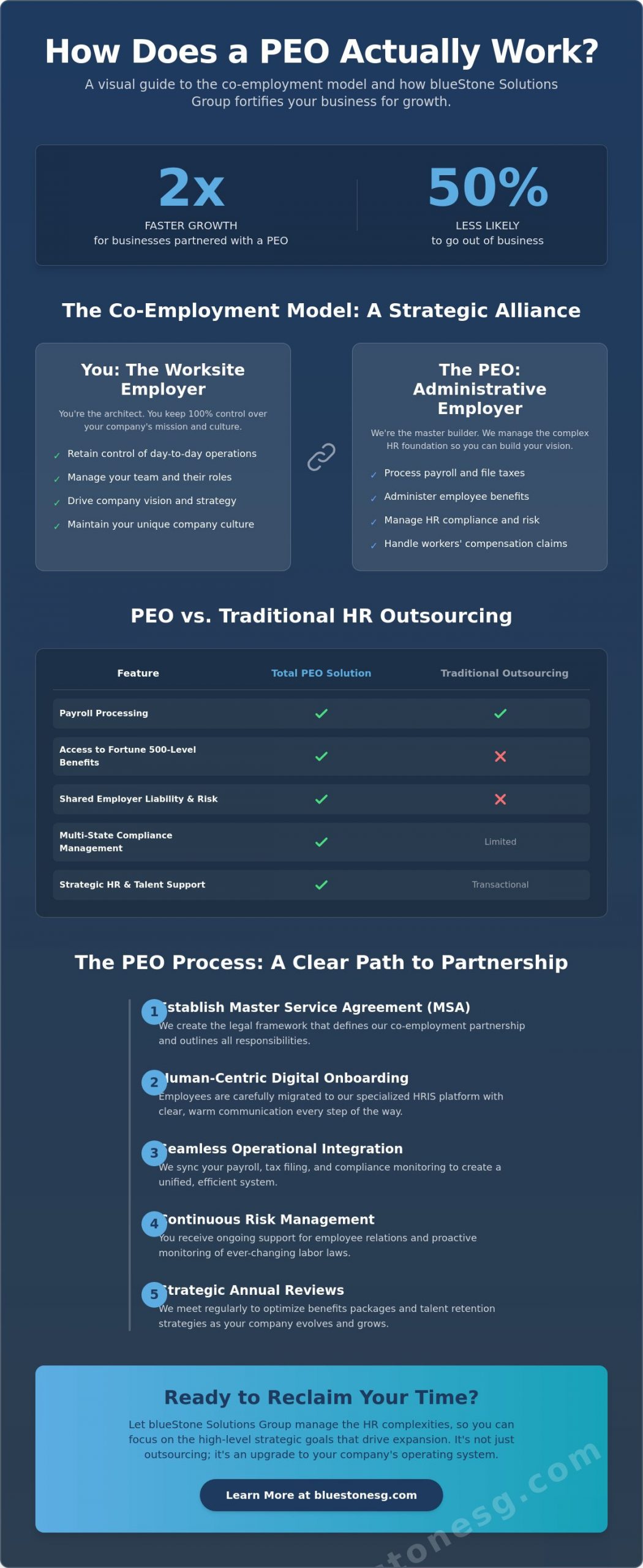
Did you know that businesses partnering with a PEO grow twice as fast and are 50% less likely to go out of business? If you’ve ever wondered how does a peo work to drive those results, you aren’t alone. Most scaling leaders eventually hit a wall where multi-state compliance paperwork and the pressure to offer elite IT benefits start to stifle their actual mission. You started your company to build something visionary, not to spend your days managing payroll cycles and fearing legal liability.
At blueStone Solutions Group, we believe scaling requires structural integrity. This guide explores the strategic advantages of the co-employment model and how it streamlines your HR operations. We’ll show you how to access better benefits for your team while freeing your leadership to focus on high-impact goals. We will walk through the mechanics of liability reduction and the practical steps to empowering your workforce through a sophisticated partnership that treats your organizational environment with the importance it deserves.
Table of Contents
- What is a Professional Employer Organization (PEO)?
- The PEO Process: A Step-by-Step Breakdown of How It Works
- Strategic Advantages for Professional and Technical Teams
- Is a PEO Right for Your Business? Implementation and Next Steps
What is a Professional Employer Organization (PEO)?
Think of a PEO as a strategic alliance rather than a simple service provider. At its core, a Professional Employer Organization (PEO) is a partner that enters into a co-employment agreement with your company to share employer responsibilities. At blueStone Solutions Group, we view this relationship as a collaborative architecture for growth. It isn’t about giving up your business; it’s about fortifying it with a professional foundation that lets you scale without the weight of administrative friction.
Many leaders ask, “how does a peo work if I want to keep my culture?” The answer is simple. You retain 100% control over the day-to-day operations, the direction of your team, and the unique environment you’ve built. While you focus on the vision, the PEO handles the complex execution of HR tasks that often distract from high-impact work.
The Concept of Co-Employment Explained
Co-employment is a contractual allocation of employer responsibilities between a PEO and a client company. In this model, the PEO serves as the Administrative Employer, while you remain the Worksite Employer.
To visualize this, imagine the relationship between an architect and a builder. You are the architect. You design the blueprint, choose the materials, and decide how the final structure should look and feel. The PEO is the master builder. They ensure the foundation is poured correctly, the permits are signed, and the structural integrity is maintained. You own the building; they simply make sure it stands strong against the elements of compliance and tax liability.
PEO vs. Traditional HR Outsourcing
While traditional HR outsourcing focuses on specific, transactional tasks like payroll processing, a PEO provides a much wider umbrella of protection. Understanding how does a peo work compared to basic payroll services is key to seeing the value. It’s the difference between hiring a bookkeeper and having a full-scale HR department at your fingertips. By pooling thousands of employees together, PEOs create economies of scale. This allows even small IT or engineering firms to access the kind of Fortune 500 benefits that attract top-tier talent.
At blueStone Solutions Group, we integrate these services to streamline your workforce management. We handle the hidden complexities of multi-state employment laws and tax filings, moving you from a reactive state of putting out fires to a proactive state of strategic expansion. This isn’t just outsourcing; it’s an upgrade to your company’s operating system.
The PEO Process: A Step-by-Step Breakdown of How It Works
Scaling your business requires a clear roadmap. When you partner with blueStone Solutions Group, we follow a chronological path to ensure your team feels supported at every turn. If you’re curious about how does a PEO work during the initial setup, it begins with a structured transition that turns administrative complexity into a streamlined engine for growth.
- Step 1: Establishing the Master Service Agreement (MSA). This is the legal framework that defines the co-employment contract and outlines the specific responsibilities of each partner.
- Step 2: Digital Onboarding. Employees are migrated into the PEO’s specialized HRIS and benefits platforms; this ensures all data is centralized and accessible.
- Step 3: Operational Integration. We sync your payroll, tax filing, and compliance monitoring to create a seamless flow of information.
- Step 4: Continuous Risk Management. You receive ongoing support for employee relations and proactive monitoring of changing labor laws.
- Step 5: Strategic Annual Reviews. We conduct regular sessions to optimize your benefits packages and talent retention strategies as your company evolves.
Setting the Foundation: Onboarding and Integration
The transition period is a critical window where employee data moves to the Total PEO system. Accuracy is paramount during this phase, but so is empathy. blueStone Solutions Group ensures this transition is human-centric; we don’t just dump data into a new database. We prioritize clear, warm communication so your employees understand their new benefits and feel confident in the switch. A successful integration sets the tone for the entire partnership, transforming a technical migration into a positive cultural milestone.
Ongoing Operations: Payroll, Benefits, and Taxes
Understanding how does a peo work on a daily basis involves looking at the integration of payroll and benefits. Under the PEO model, payroll taxes are typically reported under the PEO’s Employer Identification Number (EIN). This shift is a game changer for liability; it places the burden of accurate reporting and remittance on the provider rather than your internal team. While there are many pros and cons of a PEO to consider, the primary benefit for many is this reduction in administrative weight.
The ‘Total PEO’ approach also grants your team access to high-tier health, dental, and vision plans that are usually reserved for much larger corporations. Beyond the perks, the PEO manages the gritty details like unemployment claims and workers’ compensation audits. If you’re ready to see how these steps look for your specific team, exploring our Total PEO services is a great place to start. We handle the complex execution so you can get back to the visionary work that built your company.
Strategic Advantages for Professional and Technical Teams
Your team is the engine of your innovation. In specialized sectors like IT and engineering, the competition for high-impact talent is relentless. These professionals don’t just want a job; they want an environment that supports their personal growth and provides enterprise-level security. This is where the strategic nature of the partnership becomes clear. Understanding how does a peo work in a high-stakes technical environment is about more than administrative ease; it’s about building a foundation that attracts the best in the field.
Beyond recruitment, how does a peo work to protect your bottom line? It reduces the hidden costs of bad hires and compliance errors that can derail a scaling company. At blueStone Solutions Group, we act as the visionary architect for your organizational environment. We don’t just fill seats; we help you build a sustainable structure where technical proficiency and human-centric values coexist. Our expertise lies in matching specialized talent with the exact PEO structure needed to support their unique career trajectories.
Attracting High-Impact Talent in IT and Engineering
Specialized technical talent expects more than a competitive salary. They look for comprehensive benefits packages that mirror what global tech giants offer. For a boutique engineering firm or a growing IT shop, providing these benefits independently is often cost-prohibitive. A PEO levels the playing field. By joining a larger pool, you gain access to high-tier health plans and retirement options that signal stability to potential hires. This creates an atmosphere of professional intimacy and long-term investment, making your firm a destination for top talent rather than a stepping stone.
Mitigating Risk and Ensuring Compliance
The rise of remote-first work has made multi-state employment a compliance minefield. In 2026, the regulatory landscape is shifting rapidly. With California’s exempt salary threshold rising above $70,300 and new pay transparency laws in states like Massachusetts and Rhode Island, the margin for error is slim. A PEO assumes the responsibility for complex tasks like EEO-1 reporting and FLSA compliance. blueStone Solutions Group helps you navigate these changes with meticulous planning, ensuring your expansion into new states is frictionless and legally sound. If you’re ready to elevate your talent strategy, learn how our IT staffing and Total PEO solutions can transform your firm into a resilient, scaling powerhouse.
Is a PEO Right for Your Business? Implementation and Next Steps
Deciding to shift your HR model is a significant pivot for any leadership team. You’ve seen the mechanics of how does a peo work to reduce liability and streamline payroll, but the final question is whether it fits your specific trajectory. It’s time to look closely at your internal environment. If your executive team is spending hours on multi-state compliance instead of strategic innovation, you’re paying a high price in opportunity costs. PEOs are built for rapid, scalable expansion; they provide the scaffolding you need to grow without the structural collapses that often accompany quick scaling.
Consider your growth goals for 2026. If you’re planning to enter new markets or hire remote talent across state lines, the administrative burden will only intensify. Evaluating your current internal readiness for a professionalized HR upgrade is the first step toward a more resilient business model. At blueStone Solutions Group, we help you determine if your foundation is ready for this level of sophisticated partnership.
Evaluating Cost and ROI
Evaluating how does a peo work for your specific budget requires looking beyond the monthly administrative fee. Analyze your current HR spend. The National Association of Professional Employer Organizations (NAPEO) reports that the average ROI for businesses using a PEO is 27.2% based on cost savings alone. For every $1,000 spent on these services, a business can expect to save $1,272.
Beyond the direct financial return, consider the value of reduced turnover. Research shows that businesses using a PEO have 12% lower employee turnover on average. Short-term fees are a small investment compared to the high cost of a compliance error or losing a top-tier engineer to a competitor with better benefits. Focus on long-term strategic planning to see the true impact on your bottom line.
How to Choose the Right Partner
Not all partners are created equal. You should look for markers of reliability like IRS-Certified PEO (CPEO) status. This certification is vital because a CPEO assumes sole liability for the remittance of federal employment taxes, providing your business with a critical layer of protection. You might also look for ESAC accreditation to ensure the highest financial and ethical standards are met.
Prioritize partners who understand the nuances of specialized sectors like IT, accounting, and engineering. You need a team that speaks your language and understands the unique pressures of technical staffing. A partner who can act as a mentor-like figure will ensure your organizational environment remains a top priority. Discover how blueStone Solutions Group can architect your Total PEO strategy and help you reclaim your time for the visionary work that drives your company forward.
Build Your Future on a Stronger Foundation
Scaling a business is an artistic and incremental process. It requires a partner who understands that your internal environment is just as important as your technical output. By now, you’ve seen how does a peo work to provide the structural integrity needed for rapid growth. You can offload the weight of multi-state compliance and payroll while gaining the enterprise-level benefits that attract the world’s best IT and engineering talent. This shift isn’t just about efficiency; it’s about reclaiming your time for the high-impact goals that define your mission.
blueStone Solutions Group has spent over two decades serving as a visionary architect for companies like yours. Founded in 2000, our status as a Certified Women’s Business Enterprise (WBE) reflects our commitment to diverse, specialized leadership in the IT, Engineering, and Finance sectors. We handle the complex execution so you can stay focused on the macro vision of your success. Your team’s potential is limitless when you have the right support behind you.
Empower your workforce with blueStone Solutions Group’s Total PEO services
Let’s build something extraordinary together. Your journey toward a more resilient and empowered organization starts today.
Frequently Asked Questions
What is the difference between a PEO and a staffing company?
A staffing company focuses on recruiting and placing new talent into your organization, while a PEO manages your existing workforce through a co-employment agreement. At blueStone Solutions Group, we offer both IT staffing and Total PEO services, which means we can help you find specialized talent and then provide the administrative architecture to support them long-term. Staffing is about talent acquisition; a PEO is about ongoing management, benefits, and compliance.
Will I lose control over my employees if I use a PEO?
You retain 100% control over your company’s day-to-day operations, culture, and the direction of your team. The PEO acts as the administrative employer to handle the complex execution of payroll and taxes, but you remain the worksite employer who manages performance and strategy. This partnership actually gives you more control over your time, allowing you to focus on high-impact goals instead of being drowned by paperwork.
How does a PEO make money and how are they paid?
PEOs typically generate revenue through administrative fees that are structured as either a flat fee per employee per month or a percentage of your total gross payroll. This pricing model is designed to be predictable and transparent as your business scales. If you’re wondering how does a peo work within your budget, it’s meant to replace the fragmented costs of multiple internal systems and HR software with one integrated, professional solution.
What size company is a PEO best for in 2026?
In 2026, PEOs are most effective for small to mid-sized businesses, particularly those with 10 to 99 employees. Industry data shows that penetration is highest among companies with 20 to 49 employees, as this is often the stage where multi-state compliance and benefits management become too complex to handle internally. However, the model is highly scalable and supports any firm that needs enterprise-level infrastructure to compete for top-tier technical talent.
Does a PEO handle hiring and firing for me?
You maintain the ultimate authority to make all hiring and firing decisions for your business. The PEO provides the structural integrity to ensure these processes follow current labor laws and reduce your legal liability. Understanding how does a peo work in these sensitive moments means seeing them as a mentor-like partner that provides the meticulous documentation and compliance guidance needed to protect your organizational environment.
What happens to my current HR staff when we partner with a PEO?
Your current HR team is freed from the burden of transactional tasks like payroll processing and benefits enrollment. This shift allows them to move into high-level strategic roles, focusing on company culture, employee engagement, and long-term talent development. blueStone Solutions Group views this as an opportunity to elevate your internal staff, moving them from administrative execution to visionary planning that drives the business forward.