Did you know that the average cost of failing at multi-state payroll compliance now exceeds $845 per employee every single year? This figure, reported by IRIS Software Group in early 2026, reflects a mounting pressure on leaders who feel the weight of tracking fifty different sets of state laws. It’s exhausting to wake up worrying about an IRS audit or wondering if a single remote worker has accidentally created a new tax nexus for your entire company. At blueStone Solutions Group, we believe your payroll strategy should be a growth engine rather than a back-office burden.
Managing a workforce across state lines shouldn’t feel like a high-stakes gamble. You deserve the confidence that comes with knowing your withholding is accurate and your filings are on time. This comprehensive reference is designed to help you master the complexities of cross-border payroll while protecting your organization from costly pitfalls. We will break down the essential 2026 updates, including the impact of the One Big Beautiful Bill Act and the new $184,500 Social Security wage base. You will also find a clear roadmap for state-specific requirements, from Florida’s $15.00 minimum wage to the new Box 12 reporting codes required for your 2026 tax filings.
Need to scale cybersecurity, cloud, or AI teams faster?
blueStone Solutions Group helps enterprise firms reduce hiring delays, improve candidate quality, and streamline workforce scalability through specialized IT staffing and payrolling solutions.
• IT Staff Augmentation
• Direct Hire Technical Recruitment
• Workforce Compliance Support
• PEO & Payrolling Solutions
Schedule a workforce strategy consultation today.
Table of Contents
- Understanding the Landscape of Multi-State Payroll Compliance
- The Pillars of Compliance: Taxes, Reciprocity, and Labor Laws
- Navigating Remote Work and the Nexus Challenge
- Strategic Solutions: Why blueStone Solutions Group is Your Compliance Partner
Understanding the Landscape of Multi-State Payroll Compliance
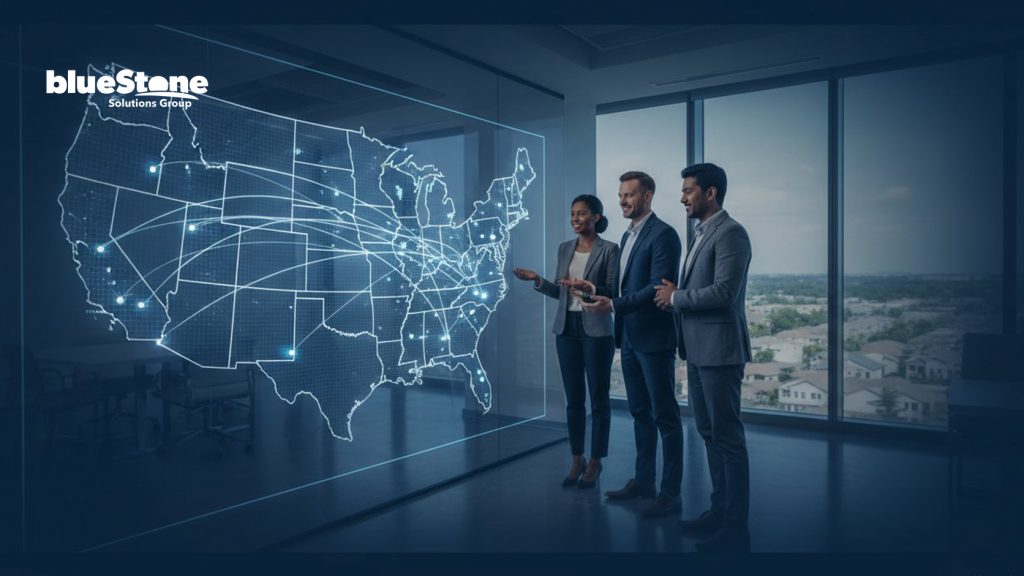
Think of your company as a borderless entity. In 2026, the traditional office has evolved into the “distributed enterprise,” where talent is sourced from wherever it lives. While this flexibility fuels growth, it also brings the challenge of multi-state payroll compliance. At its core, this is the process of adhering to varying tax, labor, and reporting laws whenever employees work in different jurisdictions. The old way of managing payroll from a single home base is failing because the rules change the moment a laptop opens in a new zip code.
A major hurdle for modern firms is the concept of “Payroll Tax Nexus.” Nexus is the legal bridge between a business and a state’s tax authority. For years, companies thought they only owed taxes where they had a physical building. Today, a single remote hire in a state like Oregon or Georgia can trigger corporate tax obligations. This shift makes the distinction between “lived-in” and “worked-in” states critical for your bottom line. Without a clear strategy, you risk over-withholding or facing surprise liabilities at year-end.
What Triggers a Multi-State Requirement?
The standards for 2026 focus heavily on economic nexus rather than just physical footprints. You don’t need a brick-and-mortar storefront to be subject to state laws. Many leaders fall for the “183-day rule” myth, believing they have half a year before compliance kicks in. In reality, some states require withholding from day one of an employee’s residency. blueStone Solutions Group acts as your visionary architect here, identifying these triggers before they turn into expensive liabilities. We help you map out where your team actually sits so your registrations stay ahead of your hiring pace.
The True Cost of Non-Compliance
Errors in payroll do more than just attract IRS attention. They damage the organizational environment you’ve worked hard to build. When an employee receives an incorrect W-2 or realizes their state disability insurance wasn’t filed, trust evaporates. Misclassification of workers also plays a massive role in failing a multi-state strategy. Treating a full-time remote worker as a contractor to avoid state taxes is a high-stakes gamble that rarely pays off. Partnering with blueStone Solutions Group ensures your compliance is grounded in reliability, keeping your brand reputation as spotless as your ledgers.
The Pillars of Compliance: Taxes, Reciprocity, and Labor Laws
Building a compliant payroll system requires a strong operational foundation across three critical areas: taxes, reciprocity agreements, and labor law compliance. Organizations managing multi-state payroll compliance must navigate far more than federal requirements like the 2026 Social Security wage base of $184,500. They are also responsible for managing dozens of unique state income tax structures, unemployment insurance requirements, and jurisdiction-specific labor regulations. ()
Some states apply relatively simplified flat-tax structures, while others use progressive tax systems with significantly higher marginal rates for top earners. State Unemployment Insurance (SUI) requirements add another layer of complexity because contribution rates and wage bases vary based on employer history and state-specific regulations. Organizations must also stay aligned with evolving workforce policies, including pay transparency mandates, paid leave requirements, and worker classification standards that differ across states and local jurisdictions.
Navigating Reciprocity Agreements
Reciprocity agreements can significantly simplify cross-border payroll compliance. These agreements allow employees who live in one state and work in another to pay income taxes only in their state of residence, reducing unnecessary withholding complexity for both employers and employees.
However, employers must still monitor special taxation rules such as New York’s “Convenience of the Employer” doctrine, which may trigger withholding obligations even when employees work remotely outside the state. Understanding these nuances is essential for organizations seeking scalable workforce flexibility without increasing payroll compliance risk.
Local Taxes and Special Districts
Payroll compliance responsibilities extend beyond federal and state regulations. Many organizations must also manage city, county, school district, and special jurisdiction taxes that introduce additional administrative complexity.
Whether dealing with occupational privilege taxes, local service assessments, or municipality-specific labor requirements, these granular compliance obligations can create unexpected liabilities if overlooked. At blueStone Solutions Group, we help organizations manage these complexities through strategic payrolling services, workforce compliance support, and scalable payroll infrastructure designed for multi-state operations. This allows enterprise leaders to focus on growth and workforce strategy while reducing administrative burden and compliance exposure.

Navigating Remote Work and the Nexus Challenge
The 2026 reality is simple: your workforce is your office. Whether your team is logging in from a mountain cabin in Oregon or a home office in North Carolina, their physical location dictates your tax obligations. This “distributed enterprise” model offers incredible freedom, but it also means multi-state payroll compliance is no longer optional. It’s the price of access to elite talent. Tracking where people actually work is a delicate balance of privacy and precision. You need to know their location for tax nexus without making them feel like they’re under a microscope.
Managing asynchronous work across various jurisdictions adds another layer of complexity. When your engineering team in California collaborates with finance pros in Florida, you aren’t just managing time zones. You’re managing different labor standards, from Florida’s $15.00 minimum wage to California’s $16.90 rate. Setting up a “New State Registration” workflow is the only way to keep hiring speed high without inviting an audit. If you wait until the first paycheck is due to register, you’re already behind.
Steps to Register in a New State
Speed and accuracy are your best friends when expanding into a new jurisdiction. Follow these four pillars to ensure a smooth transition:
- Step 1: Secure a registered agent within the new state to handle official legal and tax correspondence.
- Step 2: Apply for a State Employer Identification Number (EIN) through the local Department of Revenue.
- Step 3: Register with the State Department of Labor to establish your State Unemployment Insurance (SUI) account.
- Step 4: Create a dedicated process for ongoing reporting and tax remittance to avoid late penalties.
Streamlining the Contingent Workforce
Managing a mix of contractors and full-time staff is a legal minefield. With the US Department of Labor’s 2026 rules on joint employer status, the risk of misclassification is higher than ever. blueStone Solutions group provides payrolling services that mitigate these risks. We ensure a seamless experience for every team member, regardless of their contract status. This approach keeps you compliant with new whistleblower protections from FinCEN while maintaining the flexibility your technical projects demand. We make sure your enterprise recruitment solutions lead to long-term success, not legal headaches.
The Remote Worker Compliance Checklist
Maintaining long term stability requires a proactive approach to your organizational environment. Use this checklist to keep your multi-state payroll compliance on track:
- Verify home addresses against actual work locations every quarter to catch “digital nomads” before they trigger a new nexus.
- Review digital accessibility requirements and ensure all state-specific labor posters are available in your company’s virtual hub.
- Confirm that your workers’ compensation coverage is active and valid in every single state where you have even one employee.
Handling these details alone can lead to administrative burnout. Let the experts at blueStone Solutions Group handle the heavy lifting with our Total PEO services, so you can focus on building your visionary team.
Strategic Solutions: Why blueStone Solutions Group is Your Compliance Partner
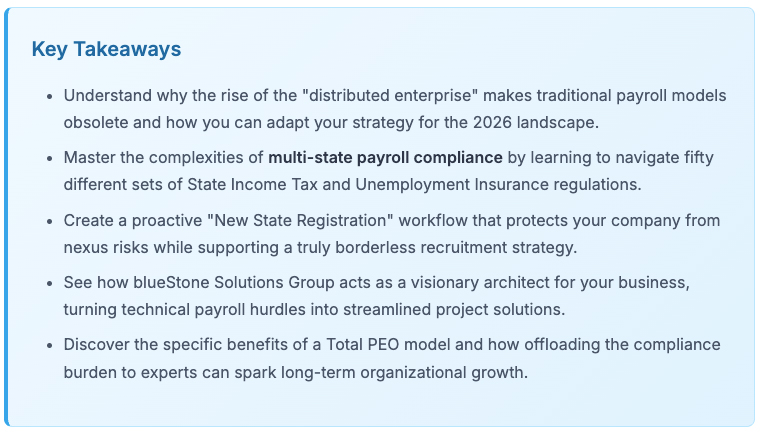
Software is a valuable tool, but it isn’t a strategy. While many platforms promise automation, they can’t provide the high-level guidance needed to navigate a world shaped by the “One Big Beautiful Bill Act” and complex tax nexus rules. blueStone Solutions Group steps in as the visionary architect of your compliance strategy. We handle the complex execution of tasks so you can breathe easier. You deserve a partner that understands the human-centric values behind every paycheck, ensuring your team feels supported as you expand across borders.
Total PEO vs. DIY Payroll
DIY payroll in a multi-state environment often leads to administrative burnout. Tracking fifty different sets of labor laws while managing your core business is a heavy lift that rarely pays off. A Total PEO model changes the equation by offloading the entire burden of multi-state payroll compliance to our team of experts. We streamline your HR operations and reduce the friction that typically slows down enterprise scaling. This allows your internal team to refocus on high-impact objectives and the long-term growth of your organization.
The blueStone Difference
Our identity as a WBE/WBENC certified organization ensures a level of meticulousness that is rare in the industry. We bring a diversity-conscious leadership style to every project, treating your organizational environment with the same care as your technical proficiency. This approach builds professional intimacy and ensures a deep investment in your success. We aren’t just a service provider; we are a thoughtful matchmaker between your ambitious goals and the regulatory reality of 2026.
Deep roots in accounting and finance staffing give us a technical edge that software-only competitors lack. We understand the precise descriptors and specialized terminology required for multi-state payroll compliance because we live in that world every day. This expertise informs our payrolling services, moving your organization from a transactional mindset to a visionary one. You can scale with confidence knowing your partner is proactive, responsive, and grounded in reliability. Reach out to blueStone Solutions Group today for a compliance audit.
Scale Your Vision Without Compliance Friction
The transition to a distributed workforce is more than a trend; it’s a fundamental shift in how successful organizations grow. You’ve seen that mastering multi-state payroll compliance requires more than just a software subscription. It demands a deep understanding of tax nexus, reciprocity agreements, and the evolving labor standards of 2026. These complexities shouldn’t be a barrier to your ambition. Instead, they can be the foundation of a borderless strategy that attracts the best talent regardless of their zip code.
blueStone Solutions Group is ready to serve as your visionary partner. As a Certified Women’s Business Enterprise (WBE) with over 25 years of specialized staffing and payroll expertise, we provide the grounded reliability your business needs to thrive. Our comprehensive Total PEO solutions take the weight of complex execution off your shoulders, allowing you to invest your energy back into your people and your mission. Partner with blueStone Solutions Group for a streamlined, compliant future. Let’s build a workplace where your goals have no boundaries.
Frequently Asked Questions
Is multi-state payroll compliance mandatory for small teams with only one remote worker?
Yes, employing even a single remote worker in a different state establishes a legal tax nexus. This connection requires your business to register with that state’s Department of Revenue and Department of Labor immediately. You must comply with local tax withholding, unemployment insurance, and specific labor laws from the first day of employment. Failing to do so can lead to surprise audits and penalties, regardless of your company’s total headcount.
Can a PEO like blueStone Solutions Group handle all my state tax registrations?
Absolutely, blueStone Solutions Group specializes in managing these complex administrative hurdles. Through our Total PEO and payrolling services, we act as the visionary architect of your expansion by handling state tax registrations and ongoing compliance management. This proactive approach ensures your business remains grounded in reliability while you focus on high-level goals. We take the meticulous work of registration off your plate so you can scale your team faster.
How much does it cost to fix a multi-state payroll error?
Fixing a payroll mistake often costs significantly more than the original tax owed. Beyond the back taxes, you face interest and penalties that contribute to the billions of dollars assessed annually against U.S. employers for inaccurate filings. When you factor in the internal cost of remediation and the damage to employee trust, the price of non-compliance becomes a heavy burden. Meticulous planning is the only way to protect your bottom line.
What happens if an employee works from a temporary location for a month?
Working from a temporary location for thirty days can still trigger withholding requirements depending on the specific state. Some jurisdictions have a “day one” rule, while others have a higher threshold for residency or earnings. It is a myth that you always have a long grace period before taxes apply. You should verify the local laws of the “worked-in” state immediately to ensure your multi-state payroll compliance remains spotless during these short stays.
Do reciprocity agreements apply to all types of state taxes?
No, reciprocity agreements typically only apply to state income taxes. They don’t usually cover other obligations like State Unemployment Insurance (SUI) or local occupational taxes. Even if a reciprocity agreement exists between two states, you still need to register for unemployment in the state where the work is physically performed. blueStone Solutions Group helps you navigate these distinctions so you don’t miss these granular, hidden layers of compliance that software often overlooks.
How do 2026 labor laws affect multi-state overtime calculations?
In 2026, overtime calculations are increasingly dictated by the labor laws of the state where the employee is physically located. New standards require precise reporting for qualified overtime compensation. If your employee works in a state with a higher minimum wage, such as California’s $16.90 or Connecticut’s $16.94, your overtime premiums must reflect those local rates. Staying current on these shifting benchmarks is essential for maintaining multi-state payroll compliance across a distributed workforce.