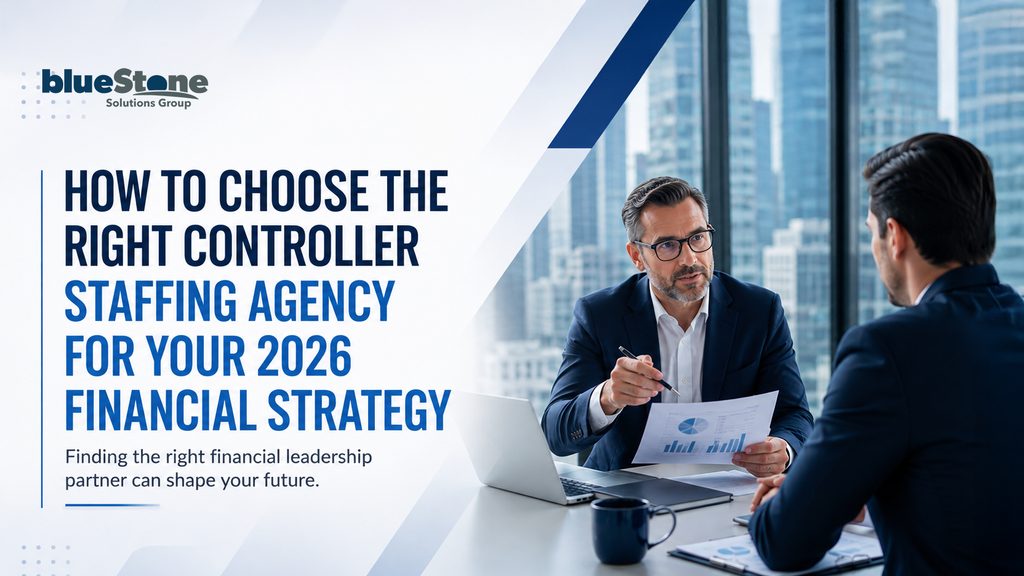
Finding the right controller is no longer simply a matter of filling an accounting position. Today’s controllers influence financial reporting, internal controls, compliance, ERP systems, process improvement, forecasting, and strategic decision-making. That makes choosing the right controller staffing agency an important business decision.
The right staffing partner should do more than send resumes. It should understand your financial environment, identify the technical capabilities your controller needs, evaluate leadership and cultural fit, and help you find a professional who can contribute beyond the immediate vacancy. At blueStone Solutions Group, we approach controller recruitment with that broader perspective. Whether you need a permanent financial controller, an interim leader, or flexible accounting and finance staffing support, the goal is the same: connect your organization with talent aligned to its business needs. So, how do you choose a controller staffing agency that can deliver that level of value?
Why Choosing a Controller Staffing Agency Starts With Strategy
Before evaluating staffing firms, start by defining what your organization actually needs from its next controller. The modern controller role can extend well beyond traditional accounting responsibilities. Depending on the organization, a controller may oversee financial reporting, accounting operations, audits, compliance, internal controls, ERP systems, process improvements, and financial data. Some organizations may need a controller who can help manage an ERP transition. Others may need someone experienced with complex reporting requirements, audit preparation, multi-entity accounting, or process automation.
The title may be the same, but the business challenge can be very different. That is why the first question should not be: “How quickly can you find us a controller?” Instead, ask: “What does our next controller need to accomplish?” Defining that answer gives your staffing partner a much stronger foundation for finding the right candidate.
The Cost of Choosing the Wrong Controller
A controller mismatch can create problems that extend far beyond the hiring process. A candidate may have impressive accounting credentials but lack experience with your ERP environment. Another may have strong technical knowledge but struggle to communicate with executive leadership or collaborate across departments.
The result can be:
- Delays in financial reporting
- Disruption to accounting operations
- Additional training requirements
- Weak communication across teams
- Problems during audits or compliance initiatives
- Increased pressure on finance leadership
- Another costly recruitment process
The objective of a controller staffing agency should therefore be more than candidate placement. It should be reducing the likelihood of a mismatch between the organization’s requirements and the professional’s capabilities.
What to Look for in a Controller Staffing Agency
Not every staffing firm approaches controller recruitment in the same way. When evaluating potential partners, look for several characteristics that demonstrate genuine accounting and finance expertise.
1. Deep Accounting and Finance Expertise
A staffing agency should understand the difference between finding an accountant, accounting manager, controller, and CFO. Ask how the firm evaluates financial leadership candidates and whether its recruiters understand the responsibilities associated with controller-level positions.
A knowledgeable controller recruiting agency should be able to discuss areas such as:
- Financial reporting
- General ledger management
- Month-end and year-end close
- Internal controls
- Audit management
- Regulatory compliance
- Budgeting and forecasting
- ERP systems
- Process improvement
- Finance team leadership
This level of understanding helps transform a job description into a more accurate candidate profile.
2. Technical Skills Should Be Validated
A resume can indicate that someone has worked with an ERP system. It does not necessarily demonstrate how effectively that person used it. Depending on your organization, your controller may need experience with platforms such as NetSuite, SAP, Oracle, or another financial technology environment. Technical evaluation should consider not only whether a candidate has used a particular system, but also how that experience relates to your business requirements.
For example, ask:
- Has the candidate managed an ERP implementation or transition?
- Have they improved financial processes using technology?
- Have they worked within complex accounting environments?
- Can they identify process and control weaknesses?
- Do they understand how financial systems support broader business objectives?
The right financial controller recruitment process should connect technical experience with the actual challenges your organization faces.
Technical Expertise Is Only Half the Equation
A controller does not work in isolation. Controllers interact with executives, accounting teams, auditors, operations leaders, technology teams, and other stakeholders. As a result, leadership and communication skills can be just as important as technical accounting knowledge.
When evaluating candidates, consider:
- Leadership style
- Communication skills
- Decision-making ability
- Collaboration
- Adaptability
- Problem-solving
- Management approach
- Ability to communicate financial information clearly
A technically strong controller who cannot effectively communicate with leadership may not deliver the value your organization expects. This is why cultural alignment should be part of the recruitment process rather than an afterthought.
Build an Ideal Candidate Profile Before You Recruit
One of the most effective ways to improve controller recruitment is to create an Ideal Candidate Profile before beginning the search. A traditional job description usually explains responsibilities. An Ideal Candidate Profile goes further. It defines the combination of technical, business, leadership, and organizational characteristics required for success. Your profile might include:
Technical requirements
- Accounting expertise
- ERP experience
- Financial reporting
- Audit and compliance experience
Business requirements
- Industry knowledge
- Multi-entity experience
- Process improvement
- Strategic financial understanding
Leadership requirements
- Team management
- Executive communication
- Cross-functional collaboration
- Decision-making
Organizational requirements
- Cultural alignment
- Work environment
- Management expectations
- Long-term career objectives
When a staffing partner understands this profile, candidate evaluation becomes much more focused.
Don’t Choose a Staffing Agency Based Only on Speed
Speed matters when a finance leadership position is vacant. But speed without quality can create a larger problem. Instead of asking only how quickly an agency can provide candidates, ask how it achieves that speed.
For example:
- How does the agency source controller candidates?
- How are candidates screened?
- How are technical accounting capabilities evaluated?
- How is ERP experience validated?
- How does the firm assess leadership ability?
- How does it evaluate cultural fit?
- How involved is the agency after interviews begin?
A strong staffing partner should be able to explain its process clearly. The objective should be speed with relevance, not simply speed with volume.
Consider Flexible Controller Staffing Options
Your organization’s needs may also determine what type of staffing solution makes sense. A permanent controller may be appropriate when you are building long-term financial leadership. An interim controller may be useful when you need immediate leadership during a transition. Staff augmentation can provide additional accounting expertise during periods of increased workload. Contract-to-hire may provide an opportunity to evaluate the relationship before making a longer-term commitment.
When evaluating controller staffing services, look for a partner capable of supporting different workforce requirements rather than forcing every organization into the same hiring model.
Specialized Expertise Is More Valuable Than a Resume Database
A large resume database does not automatically create a successful controller search. What matters is whether the staffing partner understands your organization well enough to identify which candidates are actually relevant. That starts with discovery.
A strong search should explore questions such as:
- What is changing within your finance organization?
- What challenges will the controller inherit?
- What systems does the finance team use?
- What leadership responsibilities will the controller have?
- What does success look like after 90 days?
- What should this person accomplish during the first year?
These questions give recruiters context that a job title alone cannot provide. The result is a more targeted search and a better candidate experience.
The Value of Working With a WBE-Certified Staffing Partner
Supplier diversity can also be an important consideration when organizations evaluate staffing partners. blueStone Solutions Group is a WBE-certified organization, providing an opportunity for organizations with supplier-diversity objectives to work with a certified business while addressing their accounting, finance, IT, and workforce requirements. Certification should never replace quality, expertise, or candidate fit. However, when two potential partners can deliver comparable value, supplier-diversity considerations may become an additional factor in the decision.
A Better Controller Hiring Process: Six Steps
Choosing the right controller staffing agency becomes easier when the hiring process is structured around your business needs.
Step 1: Define the Business Challenge
Start with the problem your organization needs the controller to solve. Is the priority financial reporting? ERP transformation? Internal controls? Team leadership? Process improvement? Clarify the challenge before defining the candidate.
Step 2: Create the Ideal Candidate Profile
Translate the business challenge into technical, business, leadership, and cultural requirements. This becomes the framework for evaluating candidates.
Step 3: Source and Evaluate Candidates
Your staffing partner should identify candidates based on the complete profile rather than relying solely on job titles or keyword matches. Technical experience, industry background, leadership capability, and organizational fit should all be considered.
Step 4: Conduct Focused Interviews
Interview questions should connect directly to the challenges the candidate will face. Instead of asking only about responsibilities from previous positions, explore how the candidate handled situations similar to those your organization is currently experiencing.
Step 5: Plan the Transition and Onboarding
Hiring does not end when an offer is accepted. The first weeks and months can determine how quickly a controller begins contributing. Align expectations around responsibilities, priorities, stakeholders, systems, and early objectives.
Step 6: Measure the First 90 Days
Define what success should look like after the first 30, 60, and 90 days.
Potential indicators include:
- Improved financial processes
- Stronger reporting discipline
- Better communication
- Progress on accounting initiatives
- Improved team coordination
- Greater visibility into financial performance
This also creates an opportunity for the staffing partner and employer to identify areas that may require additional support.
The Right Controller Staffing Agency Should Feel Like a Partner
The best staffing relationship does not feel like a transaction. It feels like collaboration. Your staffing partner should understand why you are hiring, what your finance organization needs, and what success looks like after the candidate joins. That means the conversation should begin with your business challenge—not simply with a job description.
At blueStone Solutions Group, our approach combines professional services experience with a human-centered recruitment process designed to understand both organizational requirements and candidate capabilities. With more than 25 years of professional services experience and expertise spanning accounting, finance, IT, and engineering, blueStone helps organizations approach talent acquisition as a strategic business decision.
Ready to Find the Right Controller?
Your next controller may influence far more than your accounting function. The right professional can strengthen financial processes, improve reporting, support compliance, lead teams, optimize systems, and contribute to broader business objectives. Choosing the right controller staffing agency is therefore about more than finding available candidates.
It is about finding a partner that understands your organization well enough to identify the right financial leader for where your business is going. If you’re planning a controller search, start with the business challenge.Talk with blueStone Solutions Group to discuss your controller staffing needs and build an Ideal Candidate Profile for your next financial leader.
Frequently Asked Questions About Controller Staffing Agencies
What should I look for in a controller staffing agency?
Look for accounting and finance expertise, a structured candidate-vetting process, ERP knowledge, leadership assessment, cultural-fit evaluation, sourcing capabilities, and flexibility across permanent and interim hiring needs.
Should I use a controller staffing agency or recruit internally?
The right approach depends on your internal recruiting resources, urgency, candidate requirements, and hiring complexity. A specialized staffing partner can provide additional sourcing reach and accounting and finance expertise when internal resources are limited or the position is difficult to fill.
Can a staffing agency help me find an interim controller?
Yes. Depending on the agency’s service model, controller staffing services may include interim, temporary, contract, contract-to-hire, or permanent recruitment solutions.
How can I evaluate a candidate’s ERP experience?
Ask candidates to explain how they used the system in previous roles rather than simply confirming that they have used it. Explore implementation, reporting, process improvement, controls, integrations, and the specific responsibilities they handled.
Why is cultural fit important when hiring a controller?
Controllers work closely with executives, finance teams, auditors, operations, and other stakeholders. Strong communication, leadership, collaboration, and adaptability can therefore be essential to long-term success.
What is an Ideal Candidate Profile?
An Ideal Candidate Profile defines the technical, business, leadership, and organizational characteristics a candidate needs to succeed in a specific role. It provides a more comprehensive hiring framework than a traditional job description.