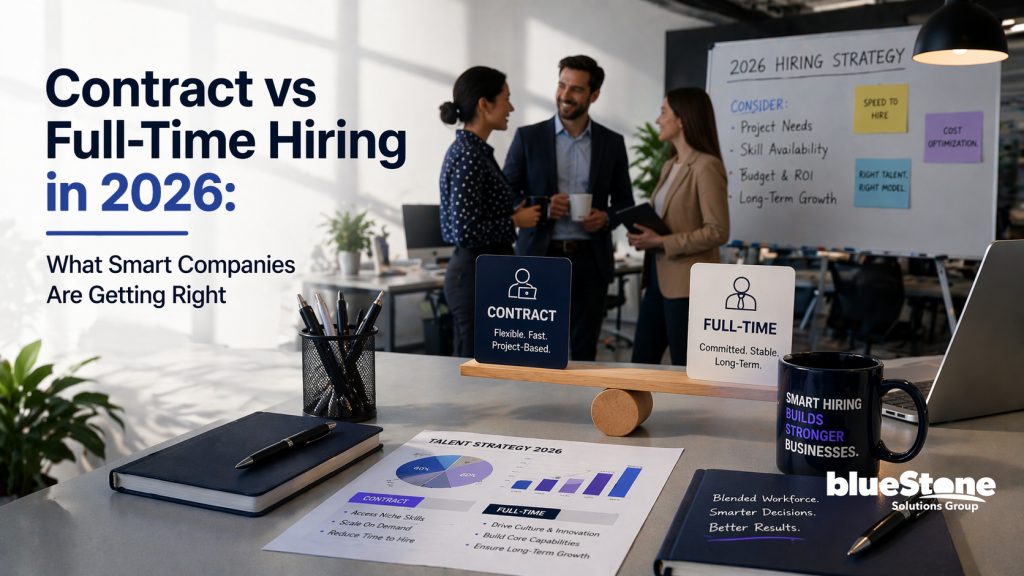
Earlier this year, a client told us something interesting: “We’re not struggling to hire—we’re struggling to decide how to hire.” And that perfectly sums up 2026. At blueStone Solutions Group, we’re seeing a clear shift. Organizations are no longer choosing between contract or full-time hiring—they’re trying to balance both to stay competitive.
The Cost Equation: Fixed vs Variable Thinking
Full-time hiring has always been seen as a long-term investment. But it comes with fixed costs—salaries, benefits, compliance, and overhead. Even recruitment itself can cost 15–30% of annual salary as a one-time fee. Contract hiring, on the other hand, shifts this into a more variable cost model. While there’s an ongoing markup (typically 25–60%), organizations avoid long-term financial commitments and reduce idle workforce costs.
In fact, 84% of companies report cost savings using contingent workers, largely due to reduced benefits and operational overhead.
blueStone POV: In 2026, cost optimization isn’t about cheaper hiring—it’s about smarter cost allocation.
Flexibility: The Real Competitive Advantage
The biggest shift we’re seeing isn’t financial—it’s structural. Markets are changing faster than ever, and businesses need talent that can adapt just as quickly. Contract hiring enables companies to bring in specialized skills on demand, without waiting months for permanent hires. It also reduces risk. If priorities shift, organizations can pivot without the long-term obligations tied to full-time roles.
Meanwhile, full-time employees bring stability, cultural alignment, and continuity—but less agility in uncertain environments.
blueStone POV: Flexibility is no longer optional—it’s a core hiring strategy.
Scalability: Building Teams That Grow With You
One of the biggest challenges companies face today is scaling at the right pace. Contract talent allows organizations to scale up during peak demand and scale down when needed, without overcommitting resources. This is why the contingent workforce is booming. The global gig economy is projected to grow to $2.18 trillion by 2034, signaling a massive shift toward flexible talent models.
At the same time, full-time hiring remains critical for building long-term capabilities and leadership pipelines. blueStone POV: The future isn’t contract vs full-time—it’s blended workforce models designed for scalability.
So, What’s the Right Approach in 2026?
Here’s what we advise our clients:
- Use contract hiring for speed, niche skills, and project-based work
- Use full-time hiring for core roles and long-term growth
- Combine both to create a flexible, scalable workforce strategy
Because the companies that win in 2026 aren’t the ones hiring more—they’re the ones hiring strategically.
Final Thought
The hiring conversation has evolved. It’s no longer about “Which model is better?”
It’s about “Which model works best—right now?”
At blueStone Solutions Group, we help organizations answer that question every day—by aligning hiring strategies with real business outcomes.