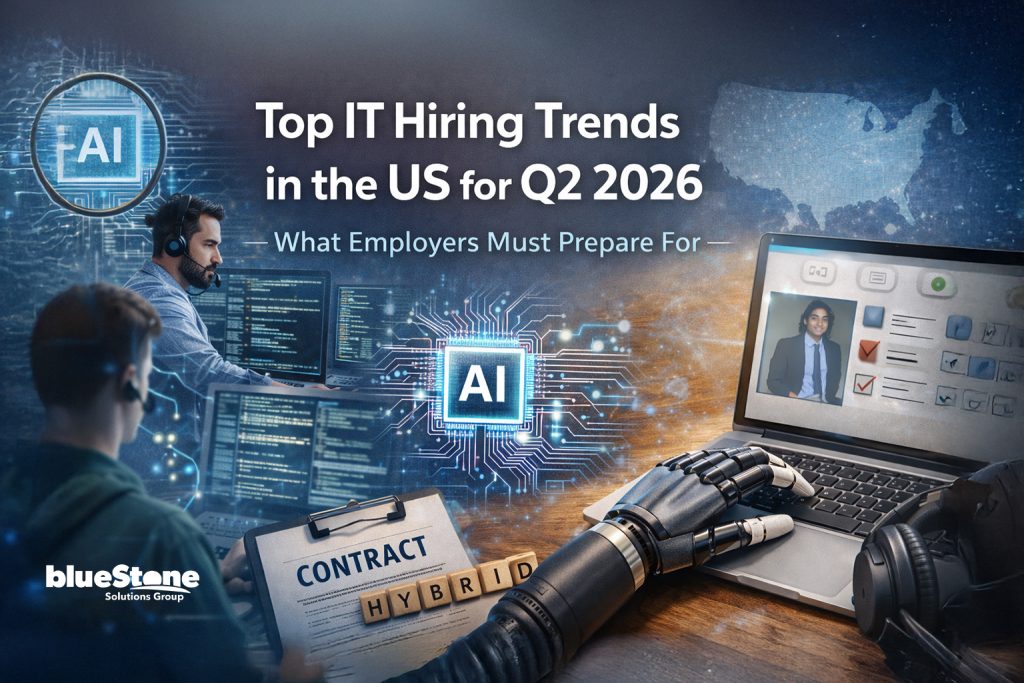
The US tech hiring market in 2026 tells a story of transformation. Not long ago, hiring was about volume—posting roles, screening resumes, and filling positions as quickly as possible. But today, something fundamentally different is unfolding. Employers are no longer just hiring talent; they’re redefining how work itself gets done.
At blueStone Solutions Group, we’re seeing this shift play out across industries. Conversations with clients are no longer limited to “How many roles do we need to fill?” Instead, they’ve evolved into deeper questions:
Do we need full-time employees or contract specialists?
How do we build AI-ready teams?
What does the future workforce actually look like?
As Q2 2026 unfolds, three powerful forces are shaping the answers—the surge in AI-driven hiring, the normalization of hybrid work, and the growing balance between contract and full-time talent.
The AI Surge: Not Fewer Jobs, But Smarter Ones
There’s a common misconception that AI is replacing jobs across the board. But what we’re witnessing is far more complex—and far more interesting.
AI isn’t reducing hiring. It’s reshaping demand.
Organizations are investing heavily in AI adoption, and with that comes a surge in demand for professionals who can build, manage, and work alongside these technologies. Roles in machine learning, data engineering, and cloud infrastructure are expanding rapidly. Even traditional software development is evolving, with companies now seeking developers who understand how to integrate AI into everyday workflows. But here’s where the real challenge begins.
The demand for AI talent is growing faster than the supply. Employers aren’t just competing for candidates—they’re competing for a very specific, highly specialized skill set. This is where many hiring strategies fall short. Job descriptions often lag behind reality, and hiring processes remain too slow for such a fast-moving market. At blueStone, we help organizations bridge this gap by aligning roles with real-world skill requirements and connecting them with pre-qualified, AI-ready talent. Because in today’s environment, success isn’t about hiring more people—it’s about hiring people who can do more.
The Hybrid Workforce: From Experiment to Expectation
If the past few years were about testing remote work, 2026 is about refining it. Hybrid work is no longer a temporary adjustment or a competitive perk—it’s the new standard. Candidates expect flexibility. Employers expect productivity. And somewhere in between lies the challenge of building teams that can operate seamlessly across locations, time zones, and digital environments. What makes this shift particularly interesting is how it’s changing hiring priorities.
Technical skills alone are no longer enough. Employers are now looking for professionals who can:
- Collaborate effectively in distributed teams
- Communicate clearly across digital channels
- Stay productive without constant supervision
In other words, how someone works has become just as important as what they know.We’ve seen organizations struggle when they treat hybrid work as simply “remote plus office.” The reality is, it requires a different mindset—one that rethinks onboarding, performance management, and team dynamics.
At blueStone Solutions Group, we guide companies in building hybrid-ready teams, ensuring that the talent they hire is not only technically capable but also equipped to thrive in a flexible work environment.
Contract vs Full-Time: A Shift Toward Workforce Agility
Another quiet but powerful shift is happening in how organizations structure their teams. The traditional model—hire full-time employees for every role—is giving way to something more dynamic.
Companies are increasingly blending:
- Full-time employees for long-term stability
- Contract professionals for speed and specialization
This isn’t just a cost-saving tactic. It’s a strategic move toward workforce agility. Consider this: when a company needs a niche skill for a short-term project, waiting months to hire a full-time employee no longer makes sense. Instead, bringing in a contract expert allows them to move faster, deliver quicker, and remain flexible. At the same time, core teams still play a critical role in maintaining continuity, culture, and long-term vision.
The challenge for employers lies in finding the right balance. Too much reliance on full-time hiring can slow down innovation. Too much dependence on contract talent can create gaps in consistency. The organizations that succeed are those that treat workforce planning as a strategic mix, not a fixed structure. At blueStone, we help clients design these blended models—ensuring they have access to the right talent, in the right format, exactly when they need it.
The Bigger Picture: Hiring Is Becoming More Strategic
What ties all these trends together is a larger realization. Hiring is no longer just an operational task—it’s a strategic function. Organizations are no longer asking, “How do we fill this role?” They’re asking, “How do we build a workforce that can adapt, scale, and compete?”
And the answer lies in:
- Embracing AI-driven change
- Building flexible, hybrid teams
- Leveraging both contract and full-time talent
Prioritizing skills over traditional credentials
Looking Ahead: What Employers Must Do Now
As Q2 2026 progresses, one thing is clear—the companies that succeed will not be the ones that react the fastest, but the ones that prepare the smartest.
They will:
- Redesign roles around AI and evolving technologies
- Build systems that support hybrid collaboration
- Adopt flexible hiring models
- Focus on quality, not just quantity
Because in this new era, hiring isn’t about keeping up. It’s about staying ahead.
How blueStone Solutions Group Helps You Navigate the Future
At blueStone Solutions Group, we partner with organizations to help them navigate this evolving landscape with confidence.
We bring together:
- Deep market insights into IT hiring trends
- Access to specialized and high-quality tech talent
- Flexible hiring solutions across contract, full-time, and hybrid models
So you’re not just responding to change—you’re leading it.