Technology teams are under increasing pressure to deliver more with specialized skills, tighter timelines, and changing business priorities. At the same time, finding highly qualified technical professionals for permanent positions can take months—especially for specialized areas such as cybersecurity, artificial intelligence, cloud computing, and data analytics.
That is where IT contract staffing can provide a strategic advantage. IT contract staffing is no longer simply a temporary solution for filling an open position. For organizations managing complex technology initiatives, it can provide a flexible way to access specialized expertise, accelerate projects, and scale technical teams around business priorities. For executives and technology leaders, the question is no longer simply, “How quickly can we fill this position?”
The better question is:
What staffing model will give our organization the right technical expertise, at the right time, without creating unnecessary long-term hiring or administrative complexity?
This guide explores how organizations can use IT contract staffing strategically in 2026, including the differences between staff augmentation and managed project solutions, how to evaluate contract IT professionals, and how to reduce compliance and administrative challenges.
What Is IT Contract Staffing?
IT contract staffing is a workforce model that allows organizations to bring qualified technology professionals into their teams for a defined period or specific business need. Instead of making every technical requirement a permanent headcount decision, organizations can engage professionals based on the skills, project requirements, and timeline involved.
For example, a company may need:
- A cybersecurity specialist during a security transformation
- An AI or machine learning engineer for a new initiative
- A cloud architect during a migration
- Data professionals for a major analytics project
- Software developers to accelerate a product release
- Infrastructure specialists during a technology modernization effort
This flexibility can be particularly valuable when an organization needs specialized expertise that is difficult to source through traditional permanent hiring. The original guide positions contract staffing as a strategic workforce tool rather than simply a “temp” solution, emphasizing the importance of matching specialized talent to an organization’s environment and objectives.
Why IT Contract Staffing Matters in 2026
Technology initiatives are becoming increasingly specialized. Organizations may have strong internal teams while still facing critical skill gaps when a new project requires expertise outside their existing capabilities. Hiring a permanent employee for every emerging technology requirement is not always practical. Contract staffing gives organizations another option.
Access Specialized Skills
Organizations can bring in professionals with experience in highly specialized areas without committing to a permanent position before the long-term need is established.
Scale Teams Around Projects
Technology projects rarely require the same level of staffing throughout their entire lifecycle. Contract professionals can help organizations increase capacity during critical implementation, development, migration, or transformation phases.
Accelerate Project Timelines
When a project is delayed because an organization lacks a particular skill, adding an experienced contract professional can help close that gap and keep the initiative moving.
Expand the Talent Pool
Remote and hybrid work models have expanded the geographic reach of technical recruiting. Organizations are no longer limited to the talent available within commuting distance of a corporate office. The source material specifically highlights the value of accessing a broader talent pool for AI, cloud, and other specialized initiatives.
IT Contract Staffing vs. Permanent Hiring
Permanent hiring remains the right choice for many core roles. However, contract staffing can make more sense when the need is specialized, time-sensitive, or project-specific.
Consider contract staffing when:
- The project has a defined timeline.
- You need a specialized skill that does not exist internally.
- Your team needs additional capacity to meet a deadline.
- You are launching or testing a new technology initiative.
- You need expertise temporarily during a transformation.
- You want to evaluate a professional before making a permanent commitment.
Contract staffing can also support a temp-to-hire strategy. The source material notes that organizations can use contract assignments to evaluate the alignment between a professional’s skills and the organization’s long-term needs before making a permanent hiring decision.
Choosing Between IT Staff Augmentation and Managed IT Solutions
One of the most important decisions is determining which staffing model best matches your project.
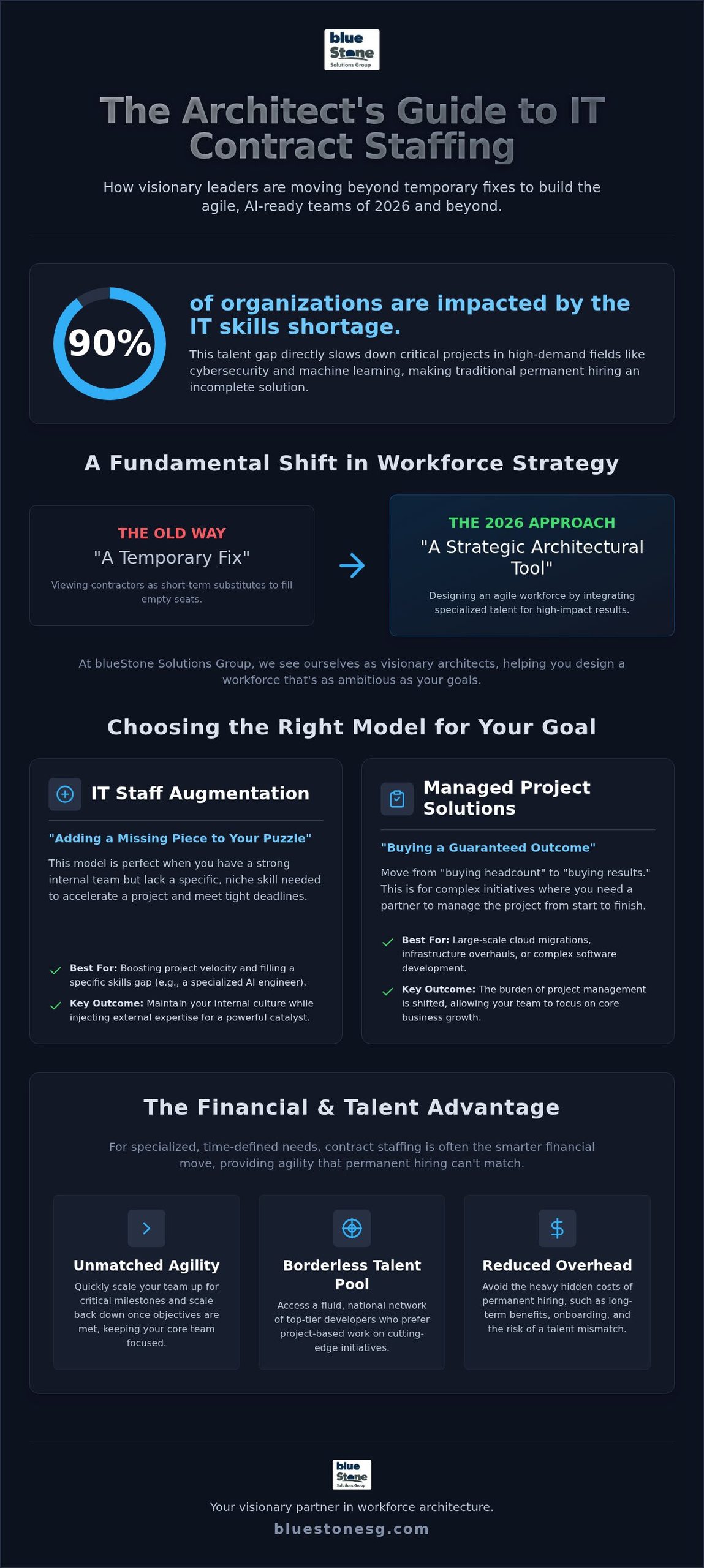
IT Staff Augmentation
Staff augmentation is typically the better choice when your organization already has an internal team but needs additional expertise or capacity. For example, your development team may have the resources to manage a product launch but lack a specialized cloud security professional. Instead of outsourcing the entire initiative, you can add the missing expertise to your existing team.
Staff augmentation can work well when you want to:
- Maintain control of project management
- Extend an existing technical team
- Add specialized expertise
- Meet an aggressive project deadline
- Preserve your existing workflows and culture
The source describes staff augmentation as particularly useful when an internal team needs a specific niche capability, such as AI engineering or cloud security expertise.
Managed IT Consulting and Project Solutions
Sometimes the challenge is bigger than a staffing gap. If your organization needs to complete a complex cloud migration, infrastructure transformation, or other technical initiative, you may need a partner that can take responsibility for delivering the broader project outcome.
This is where managed IT consulting and project solutions can be a better fit.
The distinction is simple: Staff augmentation adds expertise to your team. Managed project solutions focus on delivering an outcome.
Choosing the right model can help prevent organizations from paying for the wrong type of support or placing unnecessary project-management responsibilities on internal leaders.
How to Evaluate IT Contract Professionals
Finding someone with the right keywords on a résumé is not enough. A successful contract placement requires more than technical credentials. The professional must be able to operate effectively within the organization’s technical environment, communicate with the existing team, and contribute to the project’s objectives.
A strong IT staffing evaluation should consider four areas.
1. Technical Expertise
Does the professional have hands-on experience with the technologies required for the project?
2. Relevant Project Experience
Has the candidate solved problems similar to the ones your organization is facing?
3. Communication and Collaboration
Can the professional communicate effectively with technical and non-technical stakeholders?
4. Organizational and Cultural Fit
Will the individual work effectively within your existing team’s environment? The source recommends a multi-layered approach that combines technical assessment, soft-skill evaluation, verification of previous project outcomes, and specialized industry experience.
Why Compliance Matters in IT Contract Staffing
One of the less visible challenges of contract staffing is administration. When contractors work across different states, organizations may need to navigate varying requirements involving payroll, taxes, benefits, insurance, and worker classification. Contractor misclassification can also create significant financial and legal exposure.
That is why organizations should consider how their staffing partner handles:
- Payroll administration
- Tax requirements
- Benefits administration
- Insurance
- Worker classification
- Multi-state compliance
- Contractor onboarding
The original guide emphasizes the role of PEO and payrolling services in helping organizations manage these administrative responsibilities and reduce the burden associated with multi-state contractor management.
The Role of a Strategic IT Staffing Partner
The value of an IT staffing agency goes beyond providing résumés. A strong partner should understand what the organization is trying to accomplish before recommending talent.
That means looking at:
Business objective → Technical requirement → Talent profile → Team environment → Project outcome
This approach helps organizations avoid treating staffing as a transactional process. At blueStone Solutions Group, the source material describes this approach as a focus on understanding both the technical proficiency of candidates and the organizational environment into which they will be placed. The goal is not simply to find someone who can perform a technical task. It is to find someone who can contribute effectively to the broader objective.
Why Specialized IT Staffing Can Support Business Agility
Technology priorities can change quickly. An organization may need to increase development capacity today, add cybersecurity expertise tomorrow, and build an AI capability six months from now.
A flexible workforce strategy makes it possible to respond to those changing requirements without treating every new skill requirement as a permanent hiring decision. IT contract staffing can therefore become part of a broader workforce strategy that allows organizations to:
- Scale technical teams faster
- Access specialized expertise
- Support high-priority initiatives
- Respond to changing technology requirements
- Reduce pressure on internal teams
- Maintain focus on long-term strategic priorities
Why Choose blueStone Solutions Group for IT Contract Staffing?
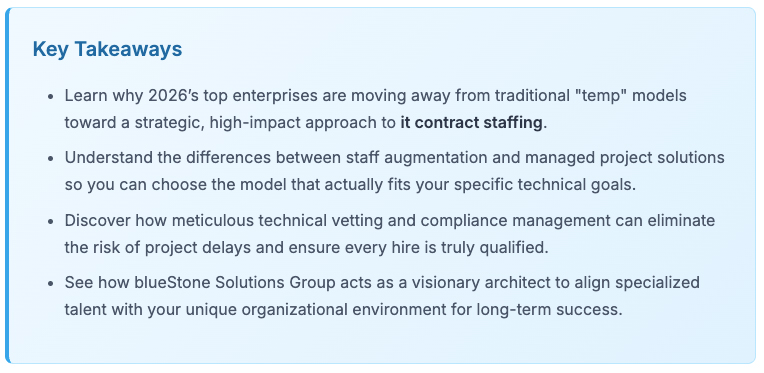
Choosing the right IT staffing partner is ultimately about more than filling an open position. It is about finding a partner that understands your technical requirements, organizational environment, project priorities, and long-term goals. According to the source material, blueStone Solutions Group focuses on specialized IT talent across areas including cybersecurity, artificial intelligence and machine learning, cloud computing, and data analytics.
The company also emphasizes:
Specialized Technical Talent
Access professionals with experience in high-demand and specialized technology areas.
Technical and Soft-Skill Vetting
Evaluate candidates beyond résumé keywords through technical assessments, experience verification, and consideration of team fit.
Flexible Staffing Models
Choose between staff augmentation, contract staffing, temp-to-hire, and broader project solutions depending on the organization’s requirements.
Payroll and Compliance Support
Use Total PEO and payrolling services to help manage the administrative complexities associated with contract professionals and multi-state requirements.
A More Personalized Approach
The source describes blueStone Solutions Group’s approach as going beyond a simple résumé match to understand the relationship between candidate capabilities, organizational culture, and strategic objectives.
Frequently Asked Questions About IT Contract Staffing
What is the difference between IT contract staffing and staff augmentation?
IT contract staffing is the broader practice of engaging technology professionals on a contingent basis. Staff augmentation is a specific model in which professionals are added to an existing internal team to provide additional skills or capacity.
When should a company use IT contract staffing?
Contract staffing can be useful when an organization needs specialized expertise, temporary capacity, project-based support, or faster access to technical talent.
Is IT contract staffing suitable for AI and cybersecurity projects?
Yes. The source specifically identifies cybersecurity, AI and machine learning, cloud computing, and data analytics as areas in which blueStone Solutions Group recruits specialized talent.
Can an IT contractor become a permanent employee?
Yes. A temp-to-hire approach can allow an organization to evaluate technical capability, team fit, and long-term alignment before making a permanent offer.
How can companies manage compliance for contract IT workers?
Organizations can work with staffing partners that provide payroll, PEO, and compliance services. These services can help manage administrative requirements associated with taxes, benefits, insurance, and multi-state employment.