


What if your next breakthrough depends less on the hardware and more on the human element? In 2026, the need to hire a mechanical engineer for a project is growing faster than ever, especially with U.S. production expected to increase by 1.3%. At blueStone Solutions Group, we’ve seen how the high cost of a bad technical hire can weigh on an ambitious team. You need more than just a resume; you need a specialist who understands niche fields like digital twins or sustainable energy and fits your unique culture.
We know that managing the administrative side of contract staff often feels like a full-time job itself. This guide will help you discover how to identify, vet, and secure top-tier engineering talent that drives your technical goals forward. We’ll preview the latest 2026 trends, from AI-driven generative design to flexible staffing models that can reduce your overhead. Let’s look at how you can bridge skill gaps quickly and ensure every project deadline is met with confidence.
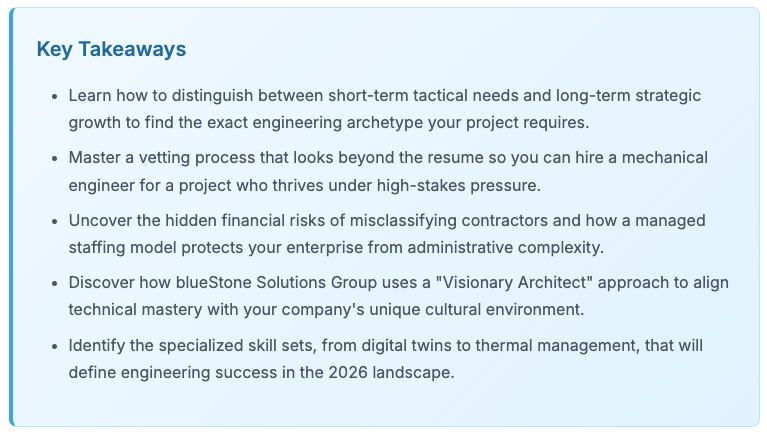
Table of Contents
- Defining Your Needs: What Does it Really Mean to Hire a Mechanical Engineer for a Project?
- The Blueprint for Success: How to Vet Mechanical Engineers for High-Stakes Projects
- Choosing Your Hiring Model: Freelance Gigs vs. Strategic Staffing Partners
- Building Your Future with blueStone Solutions Group: The Visionary Architect Approach
Defining Your Needs: What Does it Really Mean to Hire a Mechanical Engineer for a Project?
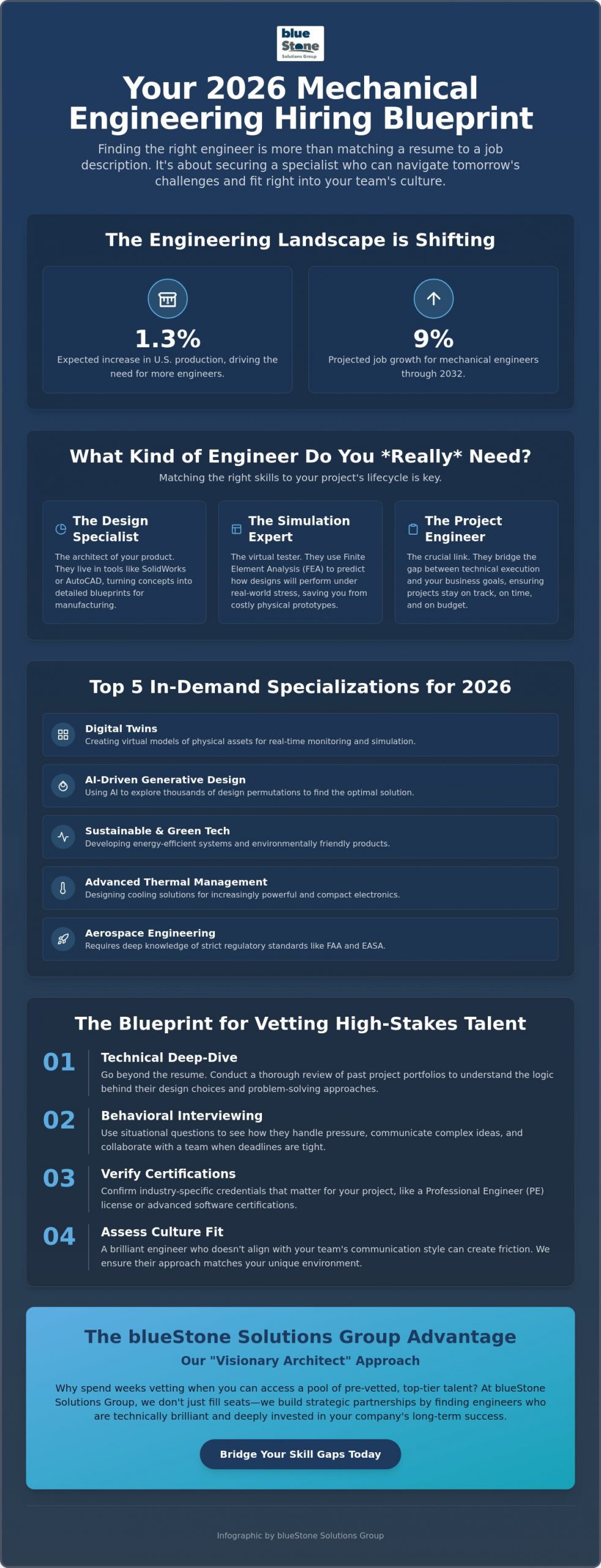
Before you search for talent, you must define the mission. To effectively hire a mechanical engineer for a project, you need to look past generic job titles. Are you building a bridge, a circuit board casing, or a turbine? Understanding what is mechanical engineering? at its core helps you see that it’s an expansive field covering everything from energy systems to manufacturing. You might need a design specialist who lives in SolidWorks or AutoCAD to create the blueprint. Alternatively, you might need a simulation expert to test those designs before they ever hit the factory floor. A Project Engineer is the bridge between technical execution and business objectives. Distinguishing between short-term tactical help and long-term strategic augmentation ensures you aren’t just filling a seat, but building a future.
Niche Specializations: Aerospace to Industrial Design
Aerospace engineering talent requires specific regulatory knowledge, such as FAA or EASA standards, to ensure safety and compliance. In the electronics sector, thermal management has become a critical pillar of modern product design as devices become smaller and more powerful. blueStone Solutions Group excels at identifying specialists in emerging green-tech sectors, ensuring your team has the vision to lead in sustainability. These niche roles require more than just technical skill; they require an understanding of how their specific piece fits into the larger puzzle.
Determining the Project Lifecycle Stage
Hiring for the prototyping phase requires a different mindset than scaling for mass production. Early on, you need Design for Manufacturing (DfM) expertise to prevent costly redesigns later. You might also require Finite Element Analysis (FEA) specialists to predict how products will react to real-world forces. When you hire a mechanical engineer for a project through blueStone Solutions Group, we help you evaluate these specific lifecycle needs. This meticulous approach ensures your project has the right support from the first sketch to the final assembly line.
The Blueprint for Success: How to Vet Mechanical Engineers for High-Stakes Projects
Vetting is an art that requires looking far beyond a list of previous employers. When you hire a mechanical engineer for a project, you’re actually looking for a partner who can navigate technical complexity while staying aligned with your broader vision. The current job outlook for mechanical engineers shows a 9% growth rate through 2032, which means the competition for top-tier talent is fierce. To secure the best, you need a meticulous evaluation process that prioritizes both technical mastery and human connection.
- Step 1: Conduct a technical deep-dive into past project portfolios to understand the logic behind their design choices.
- Step 2: Use behavioral interviewing to assess how they solve problems and manage stress under tight deadlines.
- Step 3: Verify industry-specific certifications, such as a Professional Engineer (PE) license or advanced software credentials.
- Step 4: Assess the “Organizational Environment” fit to ensure their communication style matches your existing team.
- Step 5: Partner with blueStone Solutions Group to leverage a pre-vetted talent pool that has already been meticulously screened for excellence.
Beyond the Software: Assessing Soft Skills
Communication is the most important “hidden” skill in any successful engineering project. An engineer might be a genius with CAD, but if they can’t explain their reasoning to a non-technical stakeholder, the project will face friction. We look for candidates who can document processes clearly, ensuring your project remains scalable and understandable for years to come. At blueStone Solutions Group, we prioritize “professional intimacy” in our vetting process, ensuring that every candidate we present is deeply invested in your long-term success. If you’re looking for a partner who understands this balance, our engineering staffing solutions can help you bridge the gap efficiently.
Technical Validation and Portfolio Reviews
Don’t just read the resume; look at the work itself. During a design review, ask the candidate to walk you through a specific challenge they faced in a past project. Look for “red flags” in their documentation habits, such as poor version control or a lack of clarity in their engineering notes. Peer-to-peer technical interviews are incredibly valuable here because they allow your current experts to validate a candidate’s skills in real-time. This level of scrutiny ensures that the person you bring on board is truly capable of handling high-stakes execution without constant oversight.
Choosing Your Hiring Model: Freelance Gigs vs. Strategic Staffing Partners
When you prepare to hire a mechanical engineer for a project, the first choice you face is often the most critical. You might see a freelancer listed at an average rate of $49.46 per hour and think you’ve found a bargain. However, the Total Cost of Ownership (TCO) of a managed staff augmentation model often proves more efficient. Between the time spent on administrative tasks and the risk of project delays, that “cheap” hire can become a significant liability. blueStone Solutions Group functions as a visionary partner rather than a simple vendor, ensuring that the talent you bring on board is a perfect match for your technical needs and your culture.
Misclassifying 1099 contractors in technical roles carries hidden costs that many enterprises overlook until it’s too late. Regulatory scrutiny is increasing, and the penalties for getting it wrong can be staggering. By utilizing our payrolling services or Total PEO solutions, you shift that administrative burden to us. We handle the complex tax nexus issues that arise when managing remote engineers across multiple states, allowing your team to focus on innovation instead of paperwork. A key part of this process is knowing how to vet mechanical engineers for reliability and depth, a skill we’ve honed through years of industry leadership.
The Risks of the ‘Gig’ Approach for Enterprise
Data security and intellectual property (IP) protection are paramount in engineering. Unvetted freelancers often lack the rigorous security protocols required for high-stakes projects. There is also the “ghosting” phenomenon to consider. Transactional hires often leave mid-project when a more lucrative offer appears, leaving you with unfinished designs and lost momentum. Managing the compliance of a scattered freelance workforce is a full-time job that pulls your internal HR team away from strategic goals.
The Advantages of Staff Augmentation
Strategic staff augmentation provides the continuity that complex projects demand. You keep the same high-impact talent throughout the entire project lifecycle, ensuring that institutional knowledge isn’t lost. This model also offers incredible scalability. You can add or remove specific expertise as you hit different project milestones without the typical hiring friction. blueStone Solutions Group handles the heavy lifting of HR operations, from benefits to payroll, so your project remains agile and focused.
Ready to hire a mechanical engineer for a project without the administrative headache? Discover how our Engineering Staffing services can transform your project execution today.
Building Your Future with blueStone Solutions Group: The Visionary Architect Approach
blueStone Solutions Group isn’t just another staffing agency. We are a certified Women’s Business Enterprise (WBE). This status is more than just a credential; it’s a commitment to a different kind of leadership in the engineering world. When you need to hire a mechanical engineer for a project, you aren’t just looking for a set of hands to move CAD files. You’re looking for a visionary architect who can see the long-term impact of every design choice. Our “Matchmaker” philosophy ensures we align technical labor with your strategic goals, creating a partnership of warmth rather than a cold, transactional hire.
Our expertise spans a massive range of disciplines. From high-stakes aerospace engineering to complex IT project solutions, we provide the specialized support you need to scale your operations. We treat technical labor as an incremental and artistic process. This perspective allows us to identify candidates who see the beauty in the build and the logic in the lifecycle. We don’t believe in one-size-fits-all. Every placement is a custom solution designed to drive your business forward.
Leveraging Diversity Spend with a WBE Partner
Partnering with a woman-owned staffing agency helps you meet corporate diversity goals while gaining a unique perspective on specialized leadership. Diversity in engineering leads to more innovative project outcomes because it brings varied problem-solving approaches to the table. blueStone Solutions Group understands that the organizational environment is just as important as technical proficiency. We help you find talent that doesn’t just do the work but actively enhances your team’s creative potential. This human-centric approach is what distinguishes us from traditional, dry agencies that focus solely on resumes.
Next Steps: Starting Your Search
Initiating a consultation for your specific engineering project needs is the first step toward a more reliable and productive team. During our initial organizational environment assessment, we’ll dive deep into your company culture and project requirements. We don’t just send resumes; we curate solutions. You can expect a responsive, mentor-like experience that guides you from the macro vision to the micro execution. We’re here to handle the complex execution so you can focus on the big picture.
Connect with blueStone Solutions Group to find your next engineering lead and experience a staffing partnership built on meticulous planning and long-term success.
Mastering the Future of Engineering Talent
Success in 2026 demands a shift from transactional hiring to strategic partnership. You’ve learned that defining your project’s lifecycle stage and vetting for professional intimacy are the keys to long-term impact. When you choose to hire a mechanical engineer for a project, you’re investing in more than technical output; you’re building the foundation of your company’s next innovation. It’s about finding that perfect alignment between technical mastery and your unique organizational environment.
blueStone Solutions Group brings over 25 years of specialized staffing expertise to your search. As a certified Women’s Business Enterprise (WBE), we offer a unique perspective on leadership and diversity that enriches every project we touch. From comprehensive Total PEO services to seamless payrolling, we handle the administrative complexity so you can focus on the artistic nature of your engineering work. Your vision deserves a team that is as dedicated to your goals as you are.
Ready to elevate your project? Partner with blueStone Solutions Group today. Let’s build something extraordinary together.
Common Questions About Hiring Mechanical Engineers
What is the average time-to-fill for a mechanical engineering project role?
Filling a specialized engineering role typically takes between four and six weeks on average. However, when you partner with blueStone Solutions Group, our deep talent pool significantly accelerates this timeline. We focus on matching technical proficiency with your specific culture, which helps reduce the search time. This efficiency ensures your project remains on schedule without sacrificing the quality of the individual you bring onto your team.
Can I hire a mechanical engineer for a short-term consultation or review?
Yes, you can hire a mechanical engineer for a project that covers only a specific milestone or a single design review. Many enterprises use this model to bridge specific skill gaps or get an expert second opinion on complex thermal or structural analysis. This flexible approach allows you to access high-level expertise without the long-term overhead of a permanent employee, keeping your budget lean and focused.
How do I ensure a contract engineer will sign a non-disclosure agreement (NDA)?
Protecting your intellectual property is standard practice in technical staffing. When you work with blueStone Solutions Group, we integrate NDAs and confidentiality clauses directly into the onboarding process. This ensures that every specialist is legally bound to protect your proprietary data before they ever see a single file. It’s a foundational step that provides peace of mind for high-stakes aerospace or industrial design projects.
What is the difference between a mechanical engineer and a mechanical designer?
A mechanical engineer typically focuses on the underlying physics, analysis, and structural integrity of a system, often holding a Professional Engineer license. In contrast, a mechanical designer specializes in the practical application of CAD tools to create detailed models and technical drawings. While their roles overlap, the engineer is responsible for the theoretical success of the design, while the designer focuses on its physical representation and drafting accuracy.
How does blueStone Solutions Group handle payroll and compliance for project-based hires?
We manage the entire administrative lifecycle when you hire a mechanical engineer for a project through our payrolling services and Total PEO solutions. Our team handles tax withholdings, benefits administration, and multi-state compliance for every hire. This is particularly valuable for remote teams where navigating different state tax laws is difficult. We act as the employer of record, ensuring every engineer is paid accurately and on time.
What software proficiencies are most in demand for mechanical engineers in 2026?
In 2026, proficiency in AI-driven generative design tools and digital twin platforms like Siemens NX or Dassault Systèmes is essential. Traditional mastery of SolidWorks and AutoCAD remains the industry standard, but the demand for engineers who can integrate AI into the design process has grown significantly. Understanding how to use these tools to optimize material usage and predict lifecycle performance is what separates top-tier talent from the rest of the field.


