What if the reason your critical technical roles remain vacant for months isn’t a talent shortage, but a vision gap? It’s exhausting to watch labor costs climb while skill gaps in your engineering and IT departments continue to widen. You’re likely feeling the strain of a hiring process that feels disconnected from your actual business trajectory. With 70% of the skills required for most jobs forecasted to change by 2030, mastering strategic workforce planning is no longer optional; it’s the only way to stay ahead.
At blueStone Solutions Group, we believe you deserve a talent ecosystem that grows with you. You can align your human capital with your 2026 goals through our comprehensive planning framework and template. We’re here to help you move beyond reactive hiring and toward a visionary architecture that reduces time-to-hire and builds total alignment between department heads and HR. We will walk through a clear roadmap to bridge your talent gaps and turn your workforce into your greatest competitive advantage.
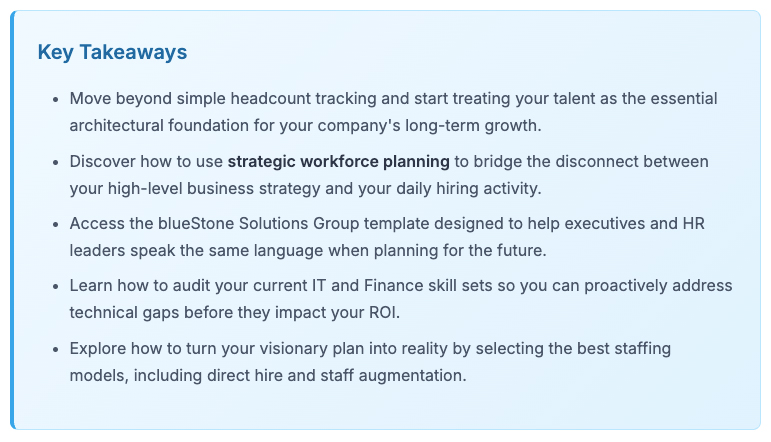
Table of Contents
- Understanding Strategic Workforce Planning: Beyond Simple Headcount
- The 5-Step Strategic Workforce Planning Framework
- Your 2026 Workforce Planning Template: A Practical Roadmap
- Bridging the Gap: Turning Your Strategy into High-Impact Talent
Understanding Strategic Workforce Planning: Beyond Simple Headcount
Stop thinking about hiring as a high-stakes game of musical chairs where you’re just trying to find a body before the music stops. Strategic workforce planning is the intentional, visionary alignment of your human capital with your most ambitious enterprise goals. At blueStone Solutions Group, we see talent as the architectural foundation of your business. If that foundation is weak or misaligned, even the most brilliant corporate strategy will eventually crumble under the pressure of execution. This discipline is a core component of strategic human resource planning; it’s about shifting your mindset from reactive “hole-filling” to proactive capacity building.
Waiting until a lead developer or senior controller quits to start your search is a recipe for rising labor costs and stagnant growth. Proactive planning allows you to anticipate technical skill obsolescence before it stalls your roadmap. By looking toward 2026, you can build a resilient team that is ready for what’s next, rather than one that’s constantly playing catch-up with yesterday’s requirements. It’s about ensuring your organization has the stability to scale without losing its soul.
The Three Pillars of Modern Workforce Architecture
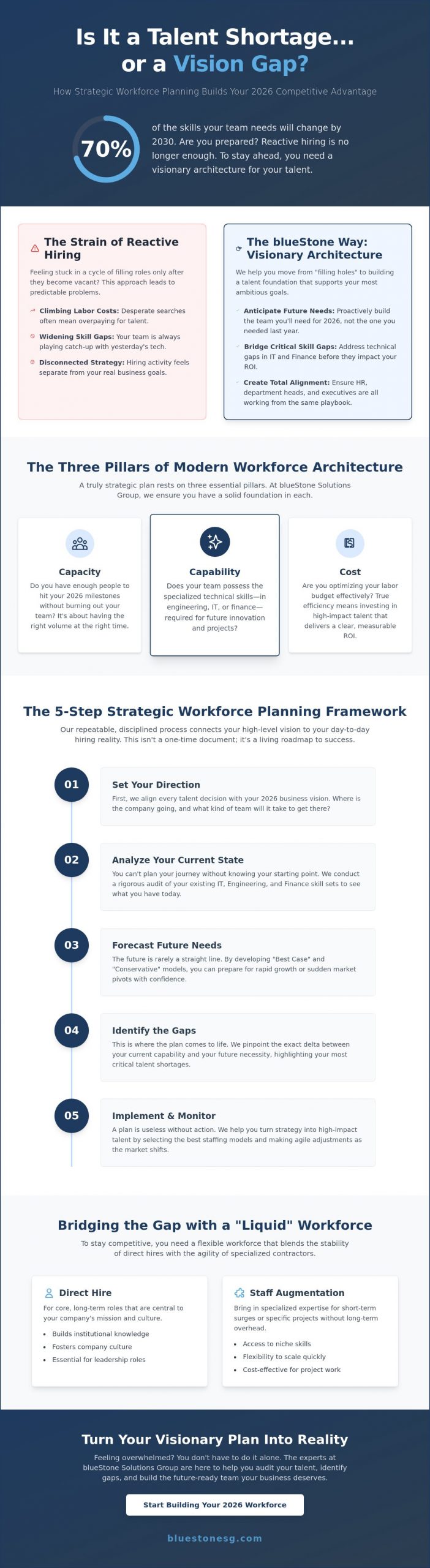
- Capacity: Do you have enough people on deck to hit your 2026 milestones? This is about volume, timing, and ensuring your team isn’t redlining.
- Capability: Does your team possess the specific technical engineering or accounting and finance expertise required for future projects? We look for the specialized skills that drive true innovation.
- Cost: Are you optimizing your labor budget and diversity spend effectively? Efficiency doesn’t mean cutting corners; it means investing in high-impact talent that delivers a clear ROI.
Why 2026 Requires a Visionary Approach
The next few years will be defined by the rapid evolution of AI and automation. These forces are rewriting technical job descriptions in real-time, making traditional roles feel suddenly outdated. To stay competitive, you need a “liquid” workforce that strategically blends direct hires with specialized contractors and IT Project Solutions. blueStone Solutions Group prioritizes interpersonal connection alongside technical mastery because, in a world of increasing automation, human-centric values are your greatest differentiator. We don’t just find people who can do the job; we find the visionary partners who will help you build the future.
The 5-Step Strategic Workforce Planning Framework
Building a visionary team doesn’t happen by accident. It requires a repeatable, disciplined approach that connects your high-level dreams to your Monday morning reality. At blueStone Solutions Group, we utilize a five-step strategic workforce planning framework designed to help you navigate the complexities of the 2026 labor market. This process ensures that every hire is a calculated step toward your ultimate destination.
First, you must set your direction by aligning every talent decision with your 2026 business vision. Second, analyze your current state through a rigorous audit of your existing IT and Finance skill sets. Third, forecast future needs by scenario planning for growth or sudden pivots. Fourth, identify the gaps by pinpointing exactly where your talent shortages lie. Finally, implement and monitor your strategy, making agile adjustments as the market shifts. This isn’t a “one and done” document; it’s a living roadmap for success.
Analyzing Your Talent Inventory
You can’t plan for where you’re going if you don’t know who is already on the bus. Start by conducting a deep-dive skill audit for your IT and Engineering teams to see which legacy skills are fading and which emerging capabilities are missing. Use your internal data to identify “flight risks” in key leadership positions. Losing a senior architect unexpectedly can derail a project for months. A skill gap is the delta between your current capability and your future necessity. If you’re feeling overwhelmed by the data, our IT Consulting services can help you decode your talent inventory and find the hidden gems within your organization.
Scenario Planning for 2026
The future is rarely a straight line. We recommend developing both “Best Case” and “Conservative” hiring models to prepare for various economic outcomes. This flexibility is vital when you need to scale projects quickly. By integrating staff augmentation into your plan, you can bring in specialized expertise for short-term surges without the long-term overhead of a permanent hire. Maintaining this level of flexibility in your IT project solutions ensures that you remain responsive to market changes while keeping your core team focused on long-term goals. It’s about being prepared for the unexpected while staying committed to your visionary path.
Your 2026 Workforce Planning Template: A Practical Roadmap
Most templates feel like a digital graveyard where data goes to die. We’ve designed the blueStone Solutions Group 2026 template to be a living, conversational tool that bridges the gap between your boardroom and your IT department. It’s a visionary roadmap that turns abstract goals into actionable talent strategies. By using this framework, you aren’t just filling out a form; you’re architecting the future of your organization. This template is divided into four distinct sections to guide your strategic workforce planning journey.
- Section 1: Executive Summary and Business Goals. Start by defining what success looks like in 2026. This ensures every talent decision is tethered to your long-term growth.
- Section 2: Current Workforce Profile. Map out your current demographics and skill sets. This isn’t just a headcount; it’s a deep dive into the human potential already within your walls.
- Section 3: Future Requirements. This is your “Dream Team” map. Define the roles and capabilities you’ll need to thrive in a more automated, AI-driven environment.
- Section 4: Action Plan. Detail your specific steps for hiring, internal training, and outsourcing. This is where your strategy becomes reality.
Mapping Technical Skill Requirements
Precision is your best friend when documenting technical needs. List the specific IT certifications or engineering licenses that will be non-negotiable for your 2026 projects. We recommend categorizing roles into “Critical,” “Core,” and “Supportive” functions. Critical roles are those that directly drive your competitive advantage, while core roles keep the engine running. Don’t forget to integrate your diversity and inclusion goals directly into this map. A diverse team brings the varied perspectives necessary for solving complex technical challenges.
Budgeting for Total Talent Cost
Financial clarity is essential for any visionary plan. You must look beyond base salaries and account for the total cost of talent, including benefits, training, and Total PEO fees. It’s also vital to factor in the “cost of a bad hire,” which can often exceed the individual’s annual salary when you account for lost productivity and recruitment time. As a WBE-certified partner, blueStone Solutions Group helps you optimize your diversity spend while ensuring you get the highest ROI on your labor budget. If you’re ready to start building, download our comprehensive planning template and begin architecting your 2026 team today.
Bridging the Gap: Turning Your Strategy into High-Impact Talent
Even the most meticulous vision remains just a dream until you actually put people into the roles. Moving from a completed template to a live search requires a nuanced understanding of different staffing models. You shouldn’t just look for permanent hires for every single need. A robust strategic workforce planning approach balances long-term stability with short-term agility. This is the stage where you decide which gaps require a permanent direct hire and which are better served by flexible IT project solutions.
Streamlining your operations is equally vital during this transition. Utilizing Total PEO and payrolling services allows your internal team to focus on high-level strategy rather than getting bogged down in administrative complexity. It’s about building a machine that can scale as fast as your vision. blueStone Solutions Group acts as your visionary partner during this phase, ensuring that the complex execution of your plan feels both seamless and supportive. We help you bridge the gap between where you are and where you need to be in 2026.
Leveraging Staff Augmentation for Agility
Sometimes, your 2026 roadmap will require specialized skills for a specific window of time. In these cases, staff augmentation is a powerful tool for maintaining momentum without the overhead of a permanent salary. It’s the ideal choice for IT project solutions where you need an expert to build the architecture, but perhaps not to maintain it forever. Managing a contingent workforce within your strategic framework gives you the power to pivot as market conditions change. Staff augmentation reduces the long-term risk of full-time over-hiring by allowing you to scale your team’s capacity up or down based on current project demands.
The blueStone Solutions Group Advantage
We aren’t just another agency; we’re matchmakers who understand the organizational environment as deeply as the technical requirements. Our specialized focus on IT, Accounting and Finance, and Engineering staffing means we speak your language and understand the nuances of your industry. Partnering with a WBE-certified firm like blueStone Solutions Group also ensures enterprise compliance and helps you meet your diversity spend goals without sacrificing quality. Once your template is complete, the next step is a successful search. Let’s turn your 2026 vision into a high-impact reality together.
Architecting Your Success for 2026 and Beyond
You now have the tools to transform your hiring from a series of urgent fixes into a deliberate, visionary architecture. By following the 5-step framework and utilizing our roadmap template, you’ve moved closer to a talent ecosystem that truly supports your 2026 goals. Strategic workforce planning is the bridge between your current capabilities and your future ambitions. It’s about making sure the right people are in the right seats at exactly the right time.
Ready to turn your plan into a reality? Since 2000, blueStone Solutions Group has provided specialized expertise in IT, Finance, and Engineering to help organizations across the United States thrive. As a certified Women’s Business Enterprise (WBE), we pride ourselves on being a thoughtful matchmaker for high-impact talent solutions. Don’t leave your future success to chance. Architect your future team with blueStone Solutions Group today. We’re excited to see what you’ll build next.
Frequently Asked Questions
What is the primary goal of strategic workforce planning?
The primary goal is to ensure your talent strategy directly supports your long-term business objectives. By focusing on strategic workforce planning, you can move beyond reactive hiring and start building a resilient team that is ready for the technical and economic shifts of 2026. It’s about finding the perfect alignment between your human capital and your visionary roadmap.
How often should an enterprise update its workforce plan?
Your plan should be a living document that you review formally at least once a year. However, the most successful organizations treat this as a continuous process with quarterly check-ins. blueStone Solutions Group recommends regular updates to account for sudden market shifts, technological advancements, and internal changes in your IT or engineering departments.
What is the difference between workforce planning and talent acquisition?
Think of workforce planning as the architectural blueprint and talent acquisition as the actual construction. Planning determines which skills you’ll need and when you’ll need them to hit your 2026 milestones. Talent acquisition is the tactical process of finding and hiring those specific individuals. One provides the strategy, while the other handles the execution.
Can small businesses benefit from strategic workforce planning?
Absolutely, because smaller teams have less room for error when it comes to labor costs. Strategic workforce planning allows small businesses to scale with intention rather than panic. It helps you decide when to use staff augmentation for specific projects and when a permanent direct hire is necessary for long-term stability.
How does a PEO service fit into a workforce strategy?
A Total PEO service handles the complex administrative tasks like payroll and compliance so your leadership can focus on high-level talent development. By outsourcing these operational burdens to blueStone Solutions Group, you free up internal resources to concentrate on visionary goals. It’s a strategic way to streamline your environment while ensuring your people are well-supported.
What are the most common pitfalls in workforce planning for 2026?
The biggest mistake is treating the plan as a static document that ignores the rapid evolution of AI. Many organizations also fail to align their hiring goals with their financial reality, leading to budget gaps. Avoid these traps by staying agile and ensuring your department heads and HR leaders are in constant communication throughout the process.